


Posts

Posts


Employer brand
This careers website checklist is for employer brand leaders who own the careers website, or should. It covers five areas: brand and design system, story and EVP, employee stories, governance and measurement. Run it before a review, a pitch or a platform decision, and you will know where the story is holding and where it is quietly breaking.
Most careers website checklists are written for whoever runs the project. They are good at the technical things: speed, accessibility, search, the apply journey. We have one of those too, our careers website audit checklist, and I would run it every year.
This one is different. It asks the questions an employer brand leader gets asked in the boardroom: does our careers website tell the truth about working here, does it say it consistently, and can we prove it is working? Those answers rarely live in a technical audit, and they are the ones that decide whether your EVP survives contact with candidates.
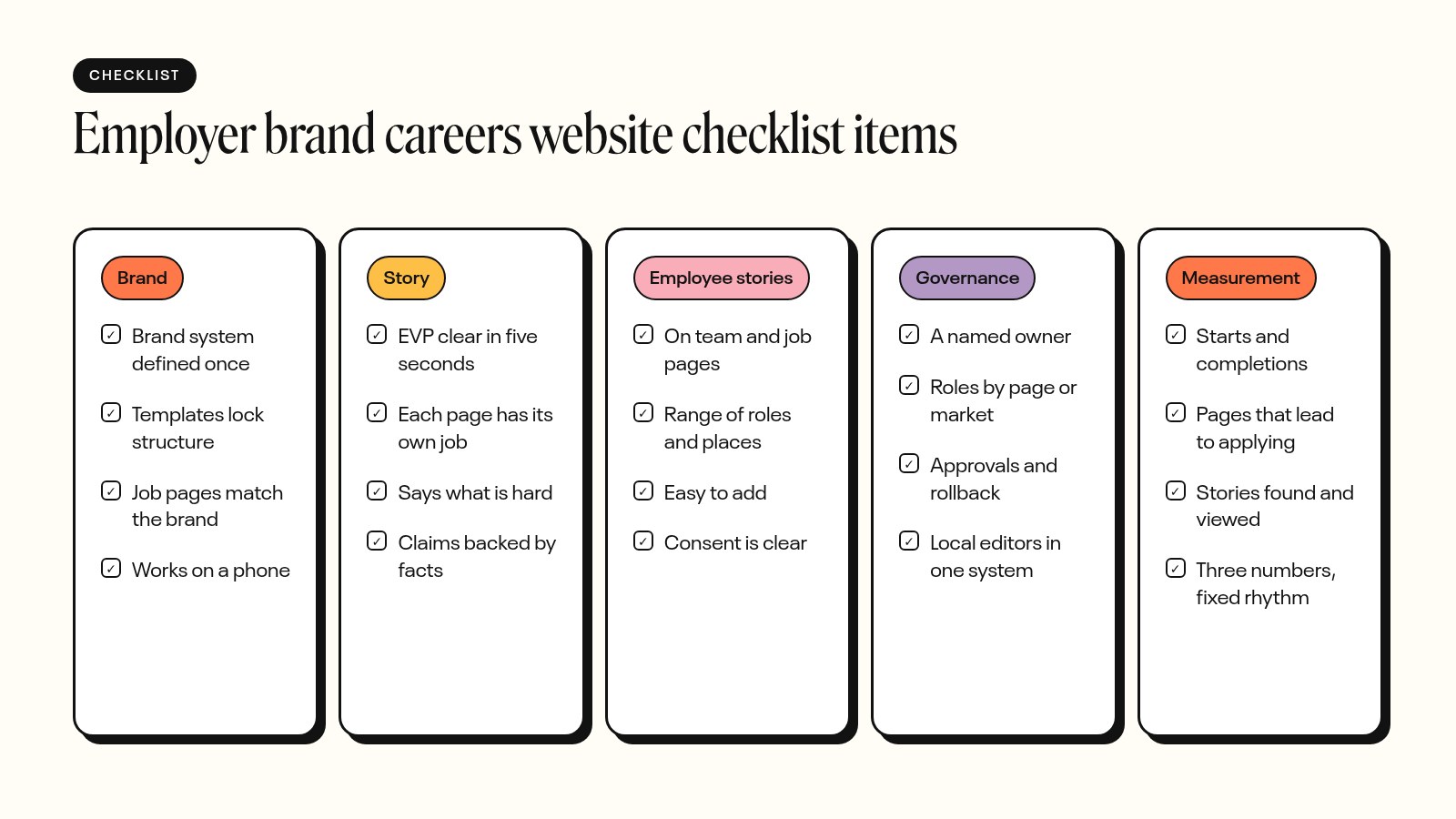
Score each line: yes, partly or no. Twenty lines, five areas.
The first four lines are about whether your brand is a system or a one-off. If your job pages look like someone else's website, that is the place to start. Candidates do not experience your careers website as a homepage and some jobs. They experience it as one brand, or as two that do not match.
Lines five to eight are where most careers websites lose points. Not because the EVP is wrong, but because it is polished into something nobody recognizes. The test I use is simple: would someone who already works here nod, or wince?
A strong EVP doesn't flatter. It filters.
That line from Sell The Truth is the standard. A careers website that filters is doing its job. One that flatters is just decoration.
For employer brand leadersCareer Site Builder for Employer Brand LeadersBrand control, storytelling, employee stories, governance and measurement in one system.See how it worksLines nine to twelve check whether your proof sits where people decide. An employee story on the right job page can do more than any brand film on the homepage. If adding a story needs a production budget, you will never have enough of them.
Lines thirteen to sixteen are the ones that protect everything else. Brands rarely break at launch. They break when the tenth person edits a page in a hurry. Roles, approvals and rollback are what let you say yes to more editors without saying goodbye to the brand.
The last four lines are about evidence. Visits are not enough. You want to know whether the right people start, continue and finish applications, and whether the stories your team published are actually being found. If you cannot answer those today, that is the most useful finding on the list.
If the checklist shows the problem is the system rather than the content, that is the moment to look at a career site builder for employer brand, built around brand control, storytelling, employee stories, governance and measurement. And if your first question is how the product itself carries your brand on every page, see the branded career site builder.
Bring your careers website and the pages your team finds hardest to keep on brand. We will show you, on a live system, how Happydance would run them.
Prefer to write? Contact us and tell us what you are working on.
A brand system that holds on every page, a true and specific story, employee stories where people decide, clear governance and measurement that goes beyond visits.
Employer brand should own the story and the templates, with TA owning jobs and the application journey, and both working in the same system with clear roles and approvals.
Every six months, and before any redesign, platform decision or major campaign.
If most of your gaps are in brand, governance or measurement, the problem is usually the system, not the content. Use the scores to brief your shortlist and test each builder against them in the demo.

About the author
Bryan Adams is the founder and CEO of Happydance and the author of Sell The Truth.
Posts

Posts

Posts