


Posts

Posts


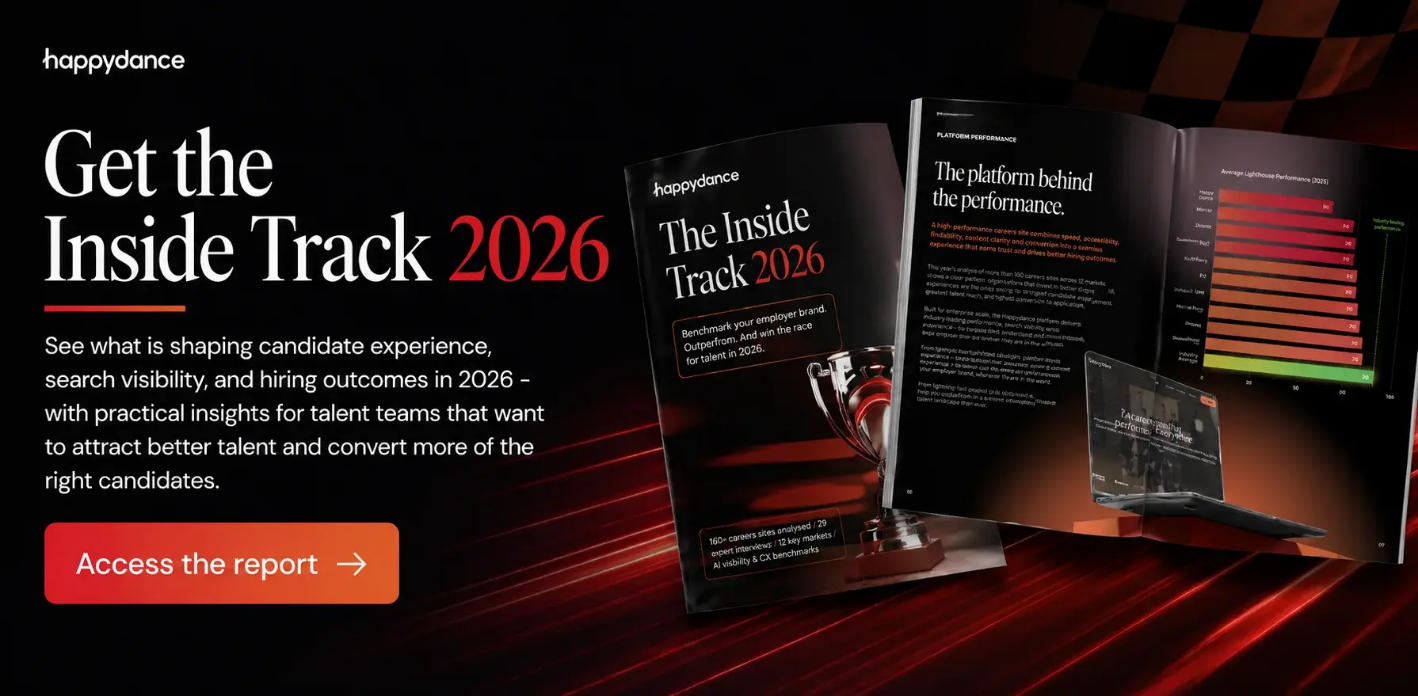
Want to see how careers websites are performing in 2026? Access The Inside Track 2026 report and explore the benchmark data.
There is a pattern running through the careers websites that are winning right now. They do not all look the same. They are not all built on the same platform. Some are from small teams, some from large organizations with dedicated resources. But they share something fundamental. They are built around the candidate's decision-making journey, not the employer's publishing workflow.
That is not a subtle difference. It changes everything downstream.
High-performing careers sites understand that candidates are not trying to experience your brand. They are trying to make a decision about whether to apply.
When a candidate lands on your careers site and the page loads in under two seconds, they are experiencing something that feels almost forgotten in hiring. They are experiencing an organization that respects their time. That feels coherent. That seems to understand that the best candidates are evaluating you as quickly as you are evaluating them.
Speed matters because it is not just a technical metric. It is a signal. A fast site signals that your organization cares about efficiency. A slow site signals the opposite. When I talk to high-performing teams about their careers site speed, they do not frame it as a technical problem. They frame it as a cultural one. They understand that a fast site reflects how you move as an organization, and candidates read that signal instantly.
Google's research on page load time found that as a page takes longer to load, the probability of a visitor leaving increases sharply - up 32% from one second to three seconds, and up 90% from one second to five seconds. Those visitors are not coming back. In a hiring context, they are candidates who already decided to look at you, and then changed their minds while your page was loading.
Most accessibility conversations in hiring sit somewhere between compliance checkbox and afterthought. High-performing teams are inverting that. They understand accessibility as a quality control mechanism. When your site is genuinely accessible, it is usually also clearer, faster, and better structured for everyone.
This is not about legal compliance. It is about signal. When a candidate with accessibility needs lands on your careers site and everything works seamlessly, they have just learned something true about your organization: you think about edge cases before they become problems. You build for real people, not for the template. That is exactly the kind of thinking you want in your culture.
The opposite is also true, and it is costly. When accessibility is bolted on as an afterthought, it shows. Candidates notice. The best candidates, in particular, notice. They are watching to see whether you genuinely think inclusion is important or whether it is something you remembered just in time.
Accessibility is not a side issue. It is a window into how your organization thinks about people who do not fit the template.
The role descriptions on high-performing careers websites read differently. They are not trying to sell the job. They are trying to tell the truth about it. What success actually looks like. What kind of person thrives in this role. What the day-to-day reality is, not the polished version. Where you are succeeding and where you are still figuring it out.
That is counterintuitive to most hiring teams. The instinct is to make the role sound as attractive as possible. Highlight the upside. Minimize the trade-offs. But the best candidates already know that every role has trade-offs. What they want is honesty. They want to understand whether the trade-offs are the kind they can live with.
When role content is genuinely clear and honest, something shifts. The candidates who apply are more aligned from the start. They have self-selected because they understand the reality and they want it. The ones who leave understood that it was not right for them, which is exactly the conclusion you want them to reach before they waste everyone's time.
High-performing sites make finding the right role easier than the average. Some do this through powerful search and filtering. Some through intelligent categorization. Some through recommendations. But all of them understand that the moment a candidate lands on your careers site, you have very little time before they decide whether it is worth exploring further.
The candidates who are most in demand have usually checked five other organizations' sites in the same browsing session. Your site is in competition for their attention against everyone else they are considering. Findability matters because it determines whether your opportunities are discoverable or buried under poor navigation.
Most teams focus on converting candidates to applications. High-performing teams focus on something subtly different: momentum. They understand that the moment a candidate has decided to apply, your job is to reduce friction, not add it. Every extra field in the application form, every unclear step, every delay in confirmation is a momentum killer.
The candidates who are most valuable are the ones with the least patience for friction. They are the ones with options. They are the ones you most want to apply. And they are also the ones most likely to abandon if you make the journey difficult.
The moment a candidate has decided to apply, your job is to reduce friction, not add it. Every extra step is a momentum killer.
What makes high-performing careers websites different is not that they are perfect at any one of these things. It is that they understand how all of these elements work together. Speed without clarity is just fast noise. Clarity without accessibility is fast noise for the people who fit your template. Findability without momentum means candidates discover your opportunity and then leave when applying feels like work.
The teams that are winning are treating the careers website as an integrated system.
They are measuring how changes in one area affect outcomes in others. They are asking whether the site is actually helping candidates make good decisions. They are obsessed with where candidates get stuck and why.
Posts

Posts

Posts