


Posts

Posts


The careers website has quietly become something it was never designed to be. For years, it sat on the periphery of hiring strategy. A place to publish jobs, a repository for culture content, a brand showcase that candidates would visit if they happened to think of you at the right moment. Nice to have. Polished. Professional.
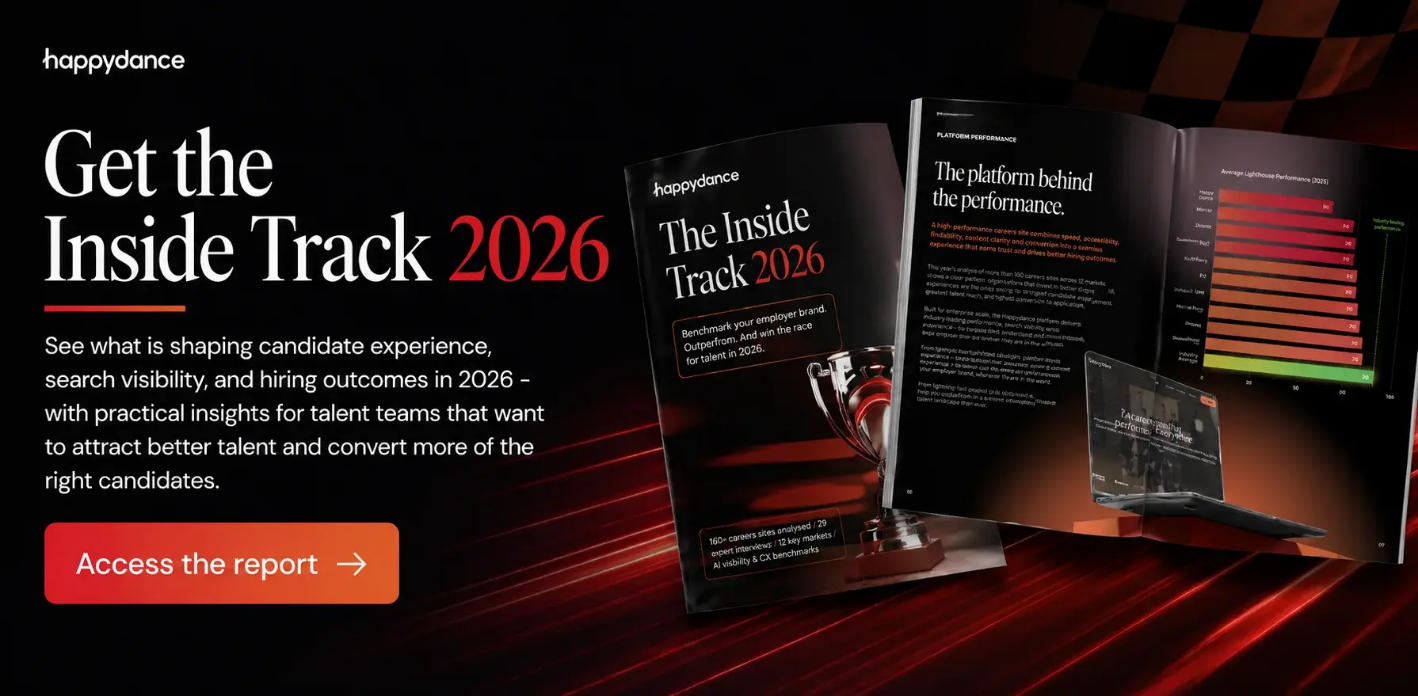
Want to see how careers websites are performing in 2026? Access The Inside Track 2026 report and explore the benchmark data.
That version of the careers website is becoming a liability.
Candidates are moving faster and judging earlier. The site that performs wins. The site that doesn't, loses before the interview ever starts.
Here is what I am watching across the strongest organizations right now: the best talent acquisition teams are treating the careers website exactly as they treat every other hiring asset. They measure it. They optimize it. They track what works and what doesn't. They understand that the candidates coming through your careers site are not a random sample. They are the people who found you, understood you well enough to click through, and decided to keep going.
That is a huge moment. And it is happening entirely on your careers website.
Most careers websites are still built to a brief that nobody would accept for any other part of hiring infrastructure. The brief is usually something like: show our culture, showcase our brand, publish our jobs, look impressive. It is a brief about appearance. And appearance is where the careers website ceases to be useful to candidates.
Candidates are not coming to your careers site to be impressed. They are coming to make a decision. They want to understand the role. They want to know if the environment suits them. They want to see the expectations clearly stated, not polished into ambiguity. They want to move forward with confidence or exit knowing they dodged a mismatch.
The strongest careers websites I am seeing are built to a completely different brief. The brief is: help candidates understand themselves against this opportunity. Reduce their uncertainty. Show them exactly what success looks like. Let them decide whether they are right for you. That brief produces something completely different from a brand showcase. It produces a performance asset.
Looking good is no longer enough. Your careers website is not a destination. It is hiring infrastructure, and it needs to perform.
When I talk about careers website performance, I am talking about the metrics that matter to candidate decision-making. Page load speed, because slow feels like negligence. Mobile usability, because your best candidates are evaluating roles on the move. Content clarity, because candidates need to understand the role and the environment well enough to decide. Findability, because the best candidates are searching across multiple opportunities simultaneously. Accessibility, because you are excluding people before you ever meet them. And conversion momentum, because the moment a candidate has decided to apply, you should not be adding friction.
In our upcoming The Inside Track 2026 study benchmarked 135 live careers websites using Google PageSpeed Insights - including 58 Fortune 100 companies. Two in three Fortune 100 careers sites score below 50 out of 100 on Performance. The average load time across those sites is 7.5 seconds. These are not organizations with limited budgets or small digital teams. They are among the most recognizable employers in the world, and their careers websites are underperforming on the metrics that matter most to candidates.
These metrics are not decorative. They are direct expressions of whether your careers website is helping candidates make good decisions about whether to move forward. And almost universally, when teams start measuring these things, they discover the gaps.
The connection between careers website performance and hiring outcomes is not indirect. When a candidate lands on your careers site and the page crawls, they are not thinking about your brand. They are thinking about whether this organization can move at the speed they need. When the role description is vague, they are not imagining themselves in the job. They are leaving to look at someone else's site where the role is clearer. When the journey from discovery to application requires five clicks instead of two, you are losing momentum exactly when you should be building it.
The candidates who are most in demand are the ones with the most options. They have already decided to explore your opportunity, which means they are already leaning in. What your careers website does next determines whether that leaning in becomes an application or another tab closed.
The question is not what the site says. It is what the site helps candidates do.
Three years ago, you could get away with a careers website that looked better than the alternatives. The bar was purely aesthetic. That window is closed. Every organization with decent budget has a professional looking careers site now, which means the visual difference is noise. Performance is now the differentiator.
The questions worth asking right now are these. How fast does your careers site load on mobile? How many candidates can clearly articulate the role after spending two minutes on your site? How many candidates who land on a specific role end up applying? Where do the drop-offs happen? Are they design choices or performance issues? Which pages are costing you the most candidate momentum? What changes would shift the metrics?
The benchmark study also offers some context for where the industry currently sits. Only 22% of Fortune 100 careers sites score 90 or above on Best Practices - the metric that captures modern web standards, security protocols and technical hygiene. More than half score below 75. On Performance, the picture is starker still: only 4 of the 58 Fortune 100 sites we measured score above 75 out of 100. The gaps are not resource problems. They are measurement problems. Most organizations simply are not asking these questions.
The strongest teams are answering these questions not once a year, but continuously. They understand that candidate expectations are moving faster than the industry is moving. They know that the sites performing best are the ones being optimized based on where candidates actually get stuck, not where the design team thinks they might.
Careers website performance is no longer a nice-to-have. It is a competitive advantage that is now measurable and no longer optional. The teams that start auditing their careers website performance now are the ones who will pull ahead on hire quality and speed before the year ends.
Posts

Posts

Posts