This is the first UK post in the Happydance series celebrating the best EVP examples by sector and market. The series now alternates between the UK and the US, following our five US lists: tech, financial services, healthcare, retail and manufacturing and automotive. This time it is UK tech: software, semiconductors, AI, IT services and the digital brands we use every day.
As always, this is a celebration, not a teardown. Every point of praise is tied to something you can read on the brands’ own careers pages today. I scored each EVP with the Happydance EVP grading framework, built on the two books behind our approach, Give & Get Employer Branding and Sell The Truth. Both start with the question every candidate is really asking: “Do I have what it takes to thrive at your organization?”
Each EVP is scored from 1 to 5 on eight criteria taken directly from Give & Get Employer Branding and Sell The Truth, for a total out of 40: the Give and Get, the whole truth (harsh realities named plainly), story proof, employee voice, distinctiveness, audience fit, alignment and proof. Ties are broken by the Give and Get, then the whole truth, then story proof.
I only scored what is public. Every quote below was copied from the brand’s own pages on 30 October 2026, and each entry links to its source. A lower score on one criterion is a note about what was visible on the pages I reviewed, not a judgement on the culture behind it. UK fintechs are saved for our UK financial services list.
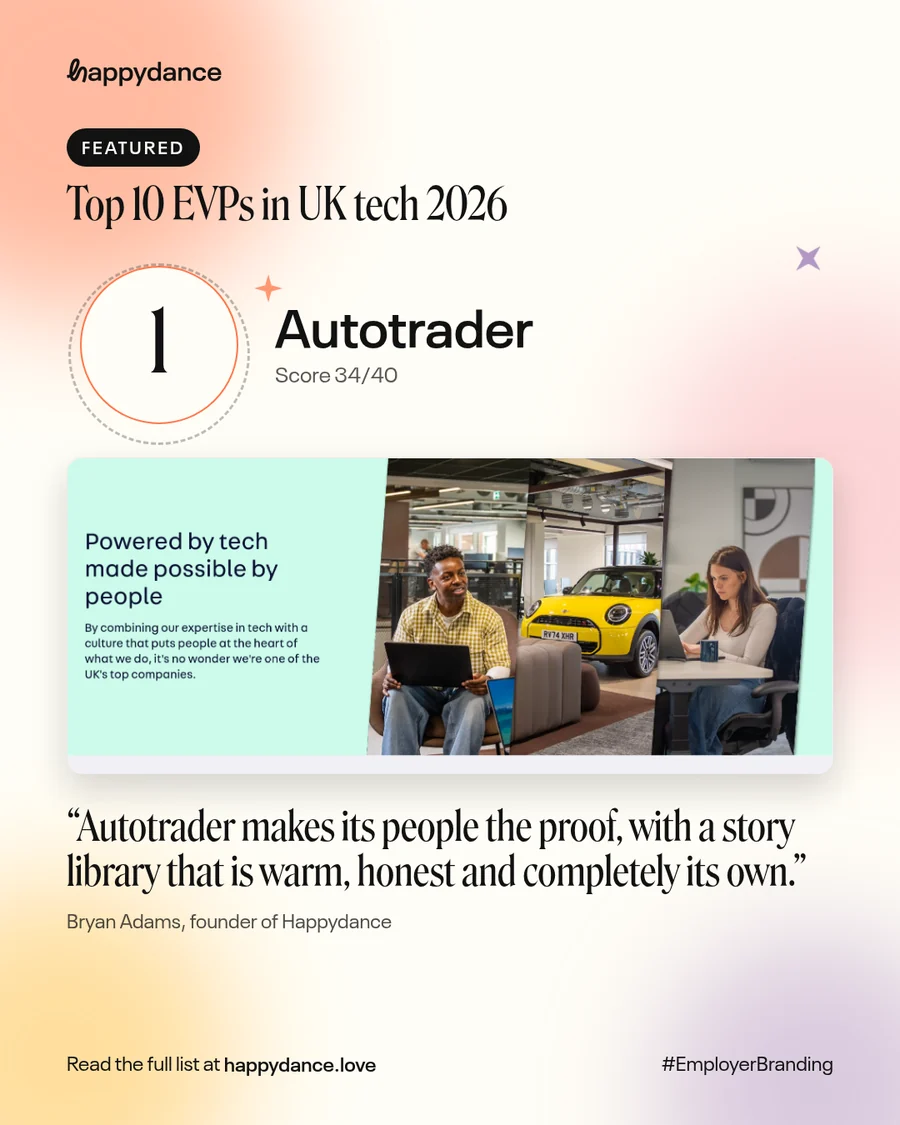
1
Autotrader
34/40
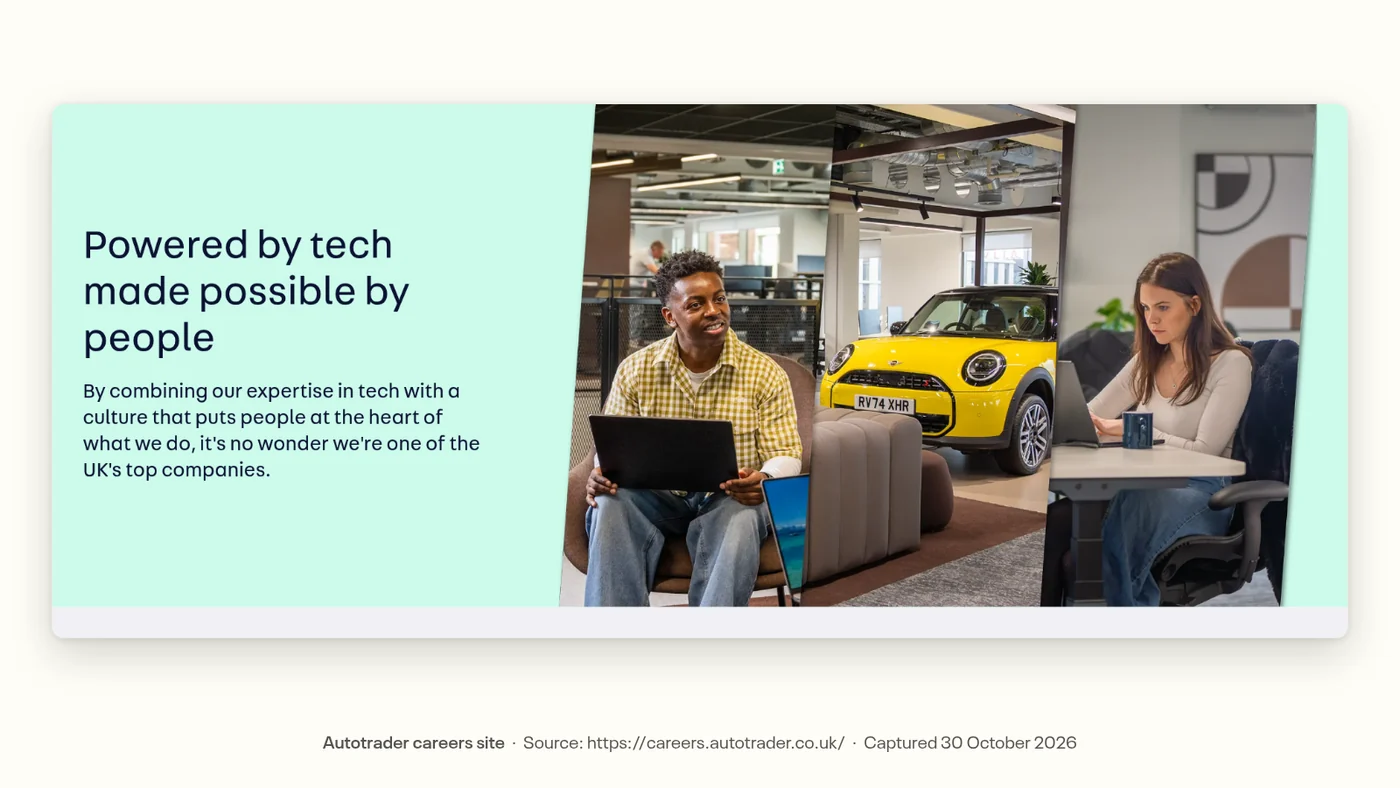
The EVP as published: “Powered by tech made possible by people”
Autotrader makes its people the proof, and it does it at scale. Its blog opens with a promise, “Our unique and inclusive culture is defined by our people.”, and then delivers dozens of named stories, each one framed around a trait: “This is Nichola, AT her most honest”. That device is clever, warm and completely its own. Its values go further than most and admit the hard parts: “We share in our failures as well as our successes.” and “We sometimes disagree, but we always commit and deliver together.”
The Give and Get
The Give is stated plainly, including the part some candidates will not love: “You'll spend a minimum of 3 days a week in the office with your team”. The Get is specific and generous: “You'll get 28 days' holiday along with bank holidays and 2 volunteer days on top of that.”, and “You get an additional 10% of your salary awarded to you in shares each year.” Naming both sides this clearly is the Give and Get done properly.
The story proof
Greg Astley, a senior developer, tells one of the most honest stories on any UK careers website. He opens with self-doubt: “I, on the other hand, am one of those anxious sorts: a little bit neurodivergent, and don't play the social game very well.” His line manager’s advice turns it: “When you're up there on stage, everyone wants you to succeed!” And Greg ends by handing the story to the reader: “If I can do it, then anyone can really... is there anything you really care about?” Conflict, change and a hero who is the employee, not the company.
What we can all learn
Give every story a frame candidates will remember. “AT her most honest” turns a library of posts into a brand, and it lets each person be the hero of their own chapter.
How to get more from the careers website
The stories are the strongest asset on the site, and the blog holds dozens of them. Bring two or three, starting with Greg’s, onto the careers homepage next to the benefits, and let candidates filter the library by team.
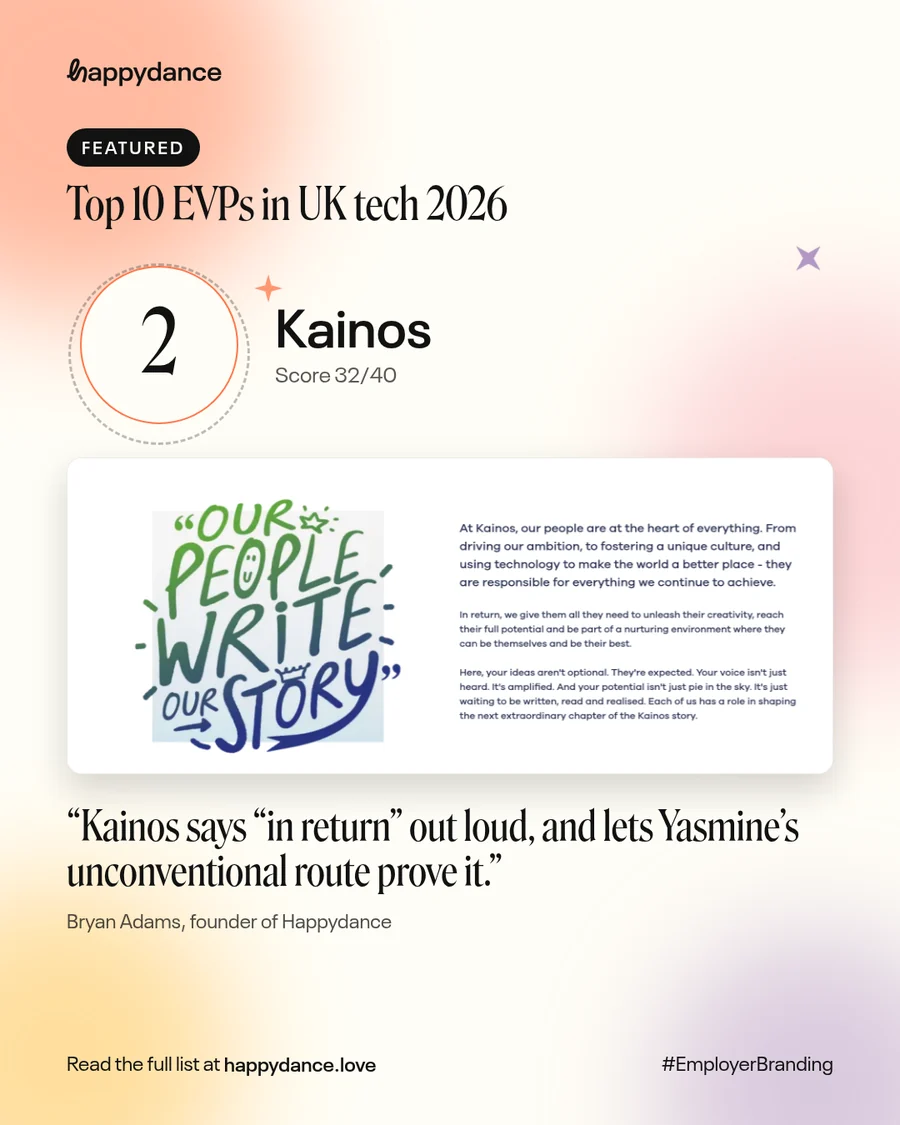
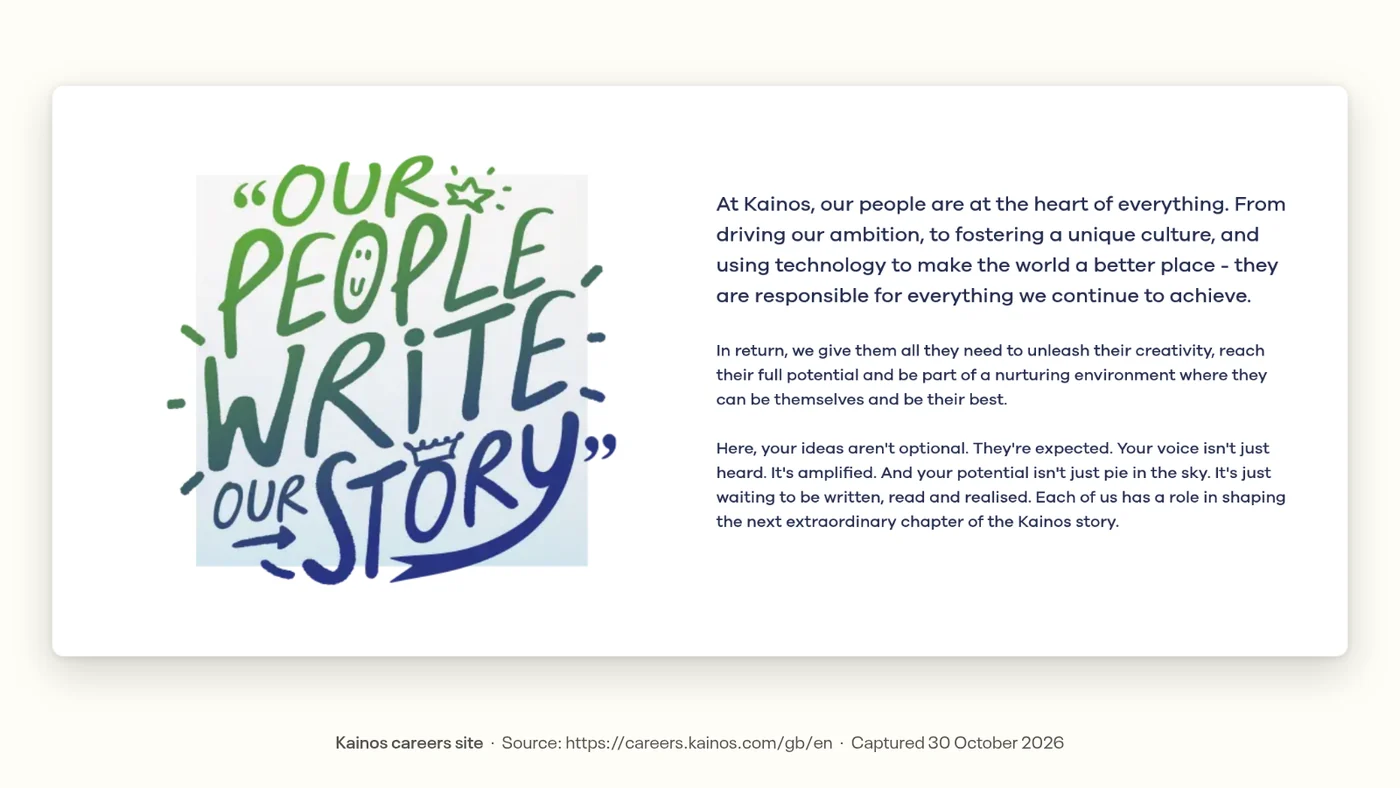
Kainos writes its EVP as a deal, in its own distinctive voice. It sets the expectation first: “Here, your ideas aren't optional. They're expected.” It names the kind of work it does: “We do work that others shy away from.” And it refuses the usual boasts: “But we measure our success not by commercial results or claims of being the best.” That is a confident, honest employer talking.
The Give and Get
The Give is ideas, voice and appetite for hard problems. The Get is spelled out in the same breath: “In return, we give them all they need to unleash their creativity, reach their full potential and be part of a nurturing environment where they can be themselves and be their best.” Few careers websites use the words “in return”. Kainos does, and that is the Give and Get in plain English.
The story proof
Yasmine Rigby’s story, “I failed ICT. Now I’m a Graduate Technologist”, is a masterclass in the whole truth. She dropped out of construction twice, worked in hospitality, and says: “At 23, I had never seen a line of code.” Her reflection is beautifully put: “I wasn’t failing to find my path. I was figuring out which paths weren’t mine.” And she is clear-eyed about what made the difference: “Access matters. Environment matters. Support matters. Opportunity matters.” At Kainos, she says, “I haven’t had to choose between developing technically and continuing the community and outreach work I care about.”
What we can all learn
Publish the unconventional route in full. A story that starts with failure and ends with a Rising Star award does more for a candidate who doubts themselves than any graduate brochure.
How to get more from the careers website
Yasmine’s story sits in the blog under Kainos Academy. Feature it, and stories like it, on the Life at Kainos page, so candidates who think tech is not for them meet someone who thought the same.
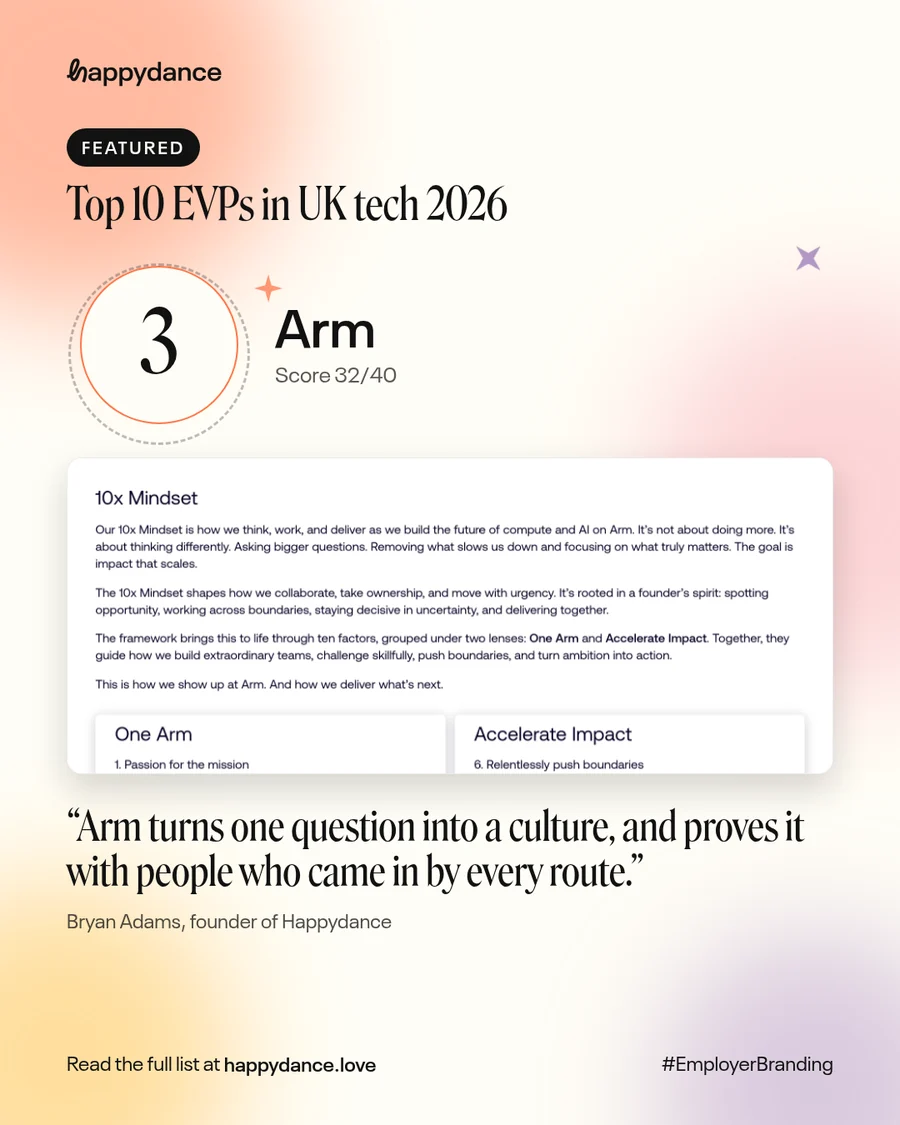
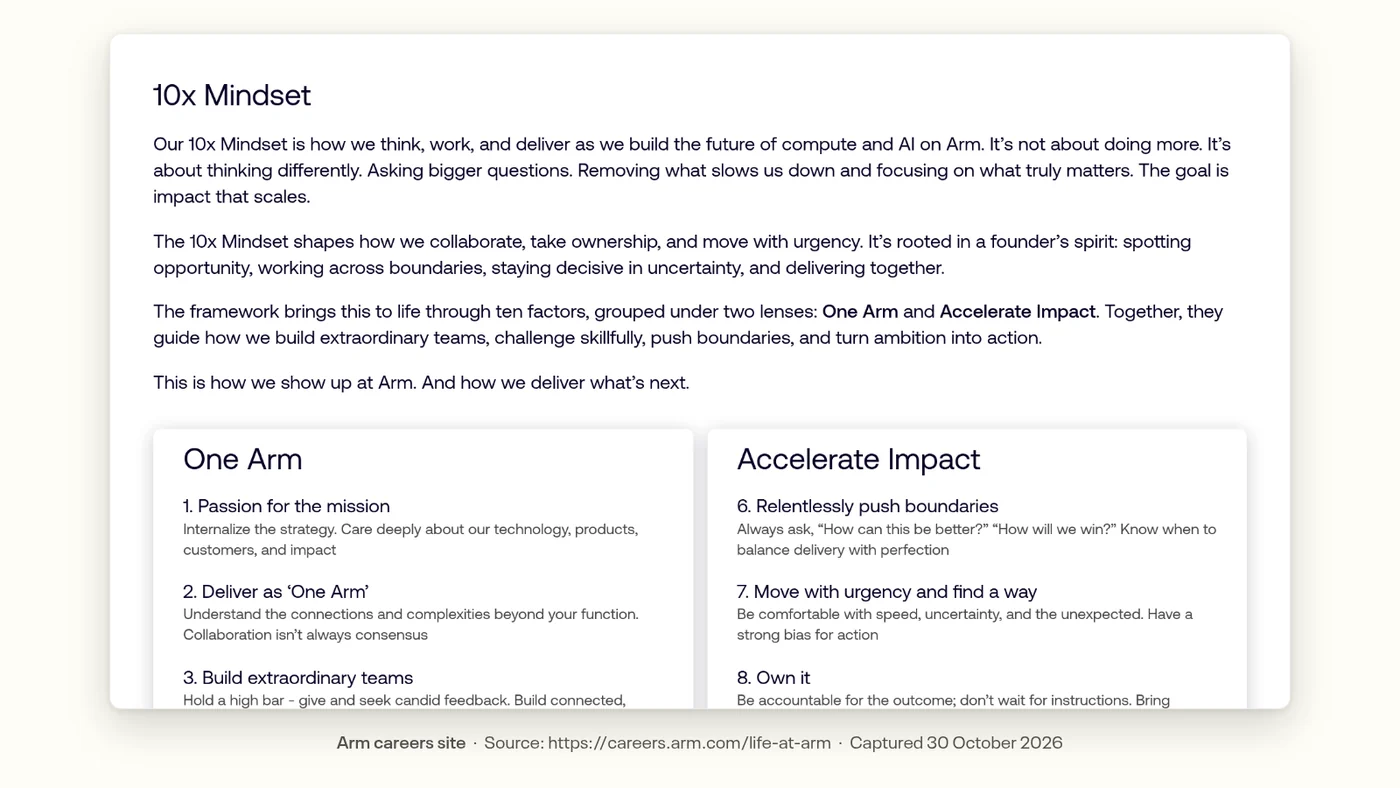
Arm turns a single question into a culture: “How do I/we make this 10 times better?” The 10x Mindset is written as behaviours you can test, and some are refreshingly direct: “Collaboration isn’t always consensus” and “Hold a high bar - give and seek candid feedback.” It is ambitious without being vague.
The Give and Get
The Give is urgency and a high bar: “Be comfortable with speed, uncertainty, and the unexpected.” The Get includes one of the most generous benefits in UK tech, explained by the people who used it: “after four years with us, employees earn a special perk: a four-week paid sabbatical!” And George shows the ladder is real: “Almost twelve years ago, George joined us as graduate.” He is now a Director, and says simply: “I got promotions when I deserved them.”
The story proof
Phil’s story is change you can feel. From a cash counting depot to an analytical role at a Category B prison where “it was a very hostile environment to work in and I knew I didn’t want a long-term career there”, to Greater Manchester Police, and finally to software engineering through an Arm apprenticeship. “Throughout all my jobs, I had a curiosity about programming but had no formal education behind me”. The Arm stories library goes on: graduates, interns, apprentices, volunteers and sabbatical takers, each named and in their own words.
What we can all learn
Let your benefits be explained by the people who use them. A sabbatical story told by Jenny and Ed is worth more than a line in a benefits grid.
How to get more from the careers website
The stories library is rich. Group it by route into Arm, such as apprentice, graduate and career changer, so someone like Phil can find a story that looks like their own.
The EVP as published: “Building the infrastructure of global finance from scratch is difficult work. We do it because solving hard problems is what we love”
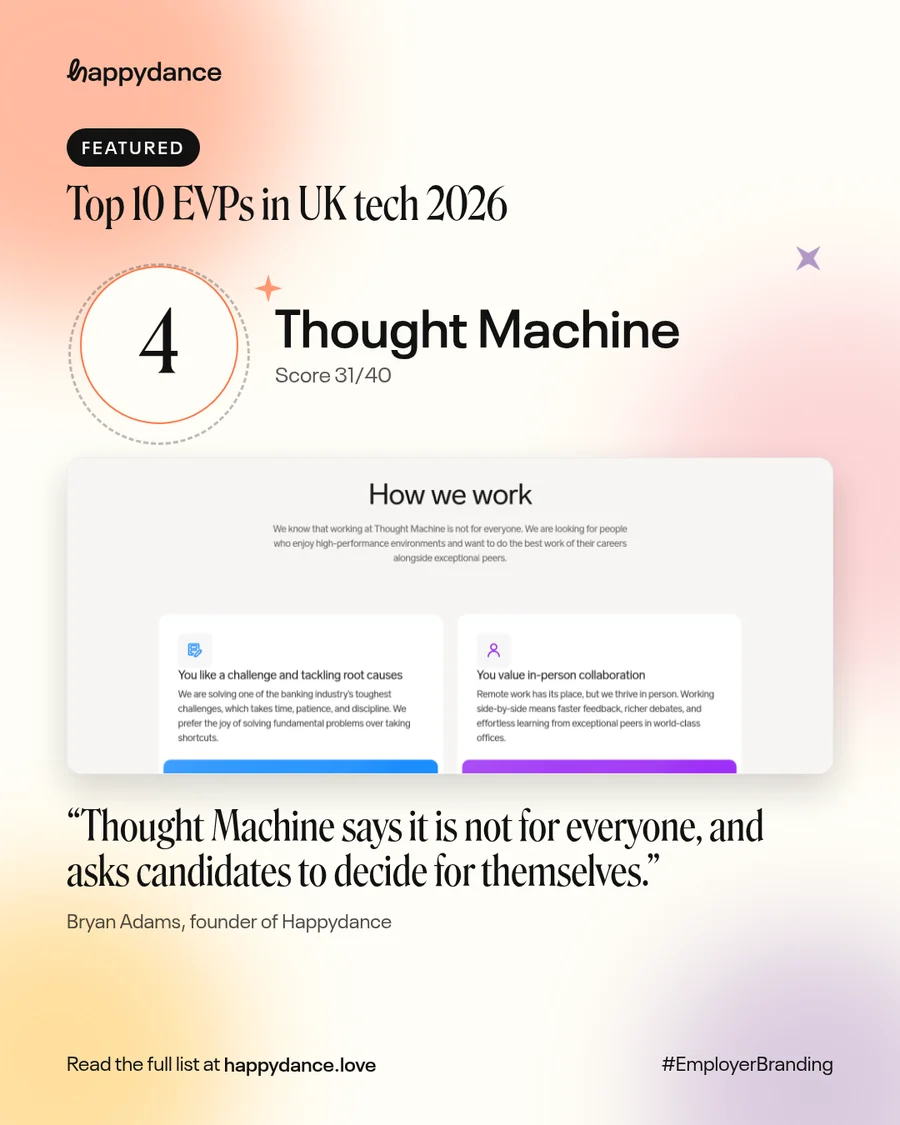
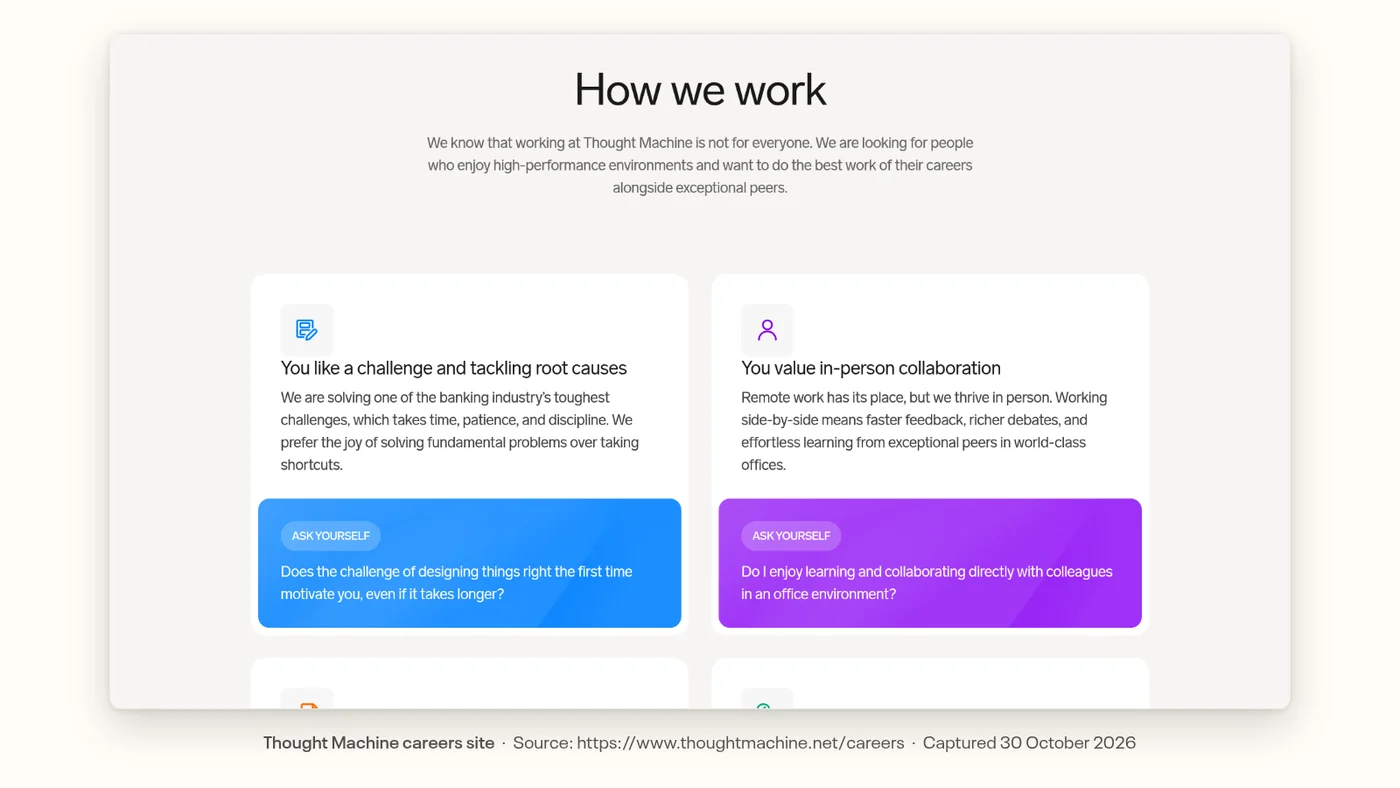
Thought Machine has the most honest careers page in UK tech. It says, without hedging: “We know that working at Thought Machine is not for everyone.” Then it does something rare and brilliant: after each way of working, it asks the candidate a question. “Am I comfortable having my ideas challenged and changing my mind when presented with better arguments?” That is the smart filter, built into the page.
The Give and Get
The Give is explicit: “You won’t be micro-managed, but you will be expected to step up.” And on location: “Remote work has its place, but we thrive in person.” The Get is just as clear: “The reason why people stay is because you get real responsibility from day one and reap the rewards of your success.”, and “Every single employee is a shareholder. When we win, everyone shares in it.”
The story proof
The founder sets the tone himself. Paul Taylor, Founder and CEO: “We aren't here to play it safe or make incremental updates.” What the page does not yet have is employee stories, which is why Thought Machine scores lower on story proof and employee voice. The honesty is all there; the people are the missing piece.
What we can all learn
Ask candidates to answer for themselves. A question like “Am I comfortable having my ideas challenged” filters better than any list of requirements, and it respects the reader.
How to get more from the careers website
Pair each “Ask yourself” question with a short first-person story from someone who answered yes, so candidates can see what stepping up and debating then committing look like in practice.
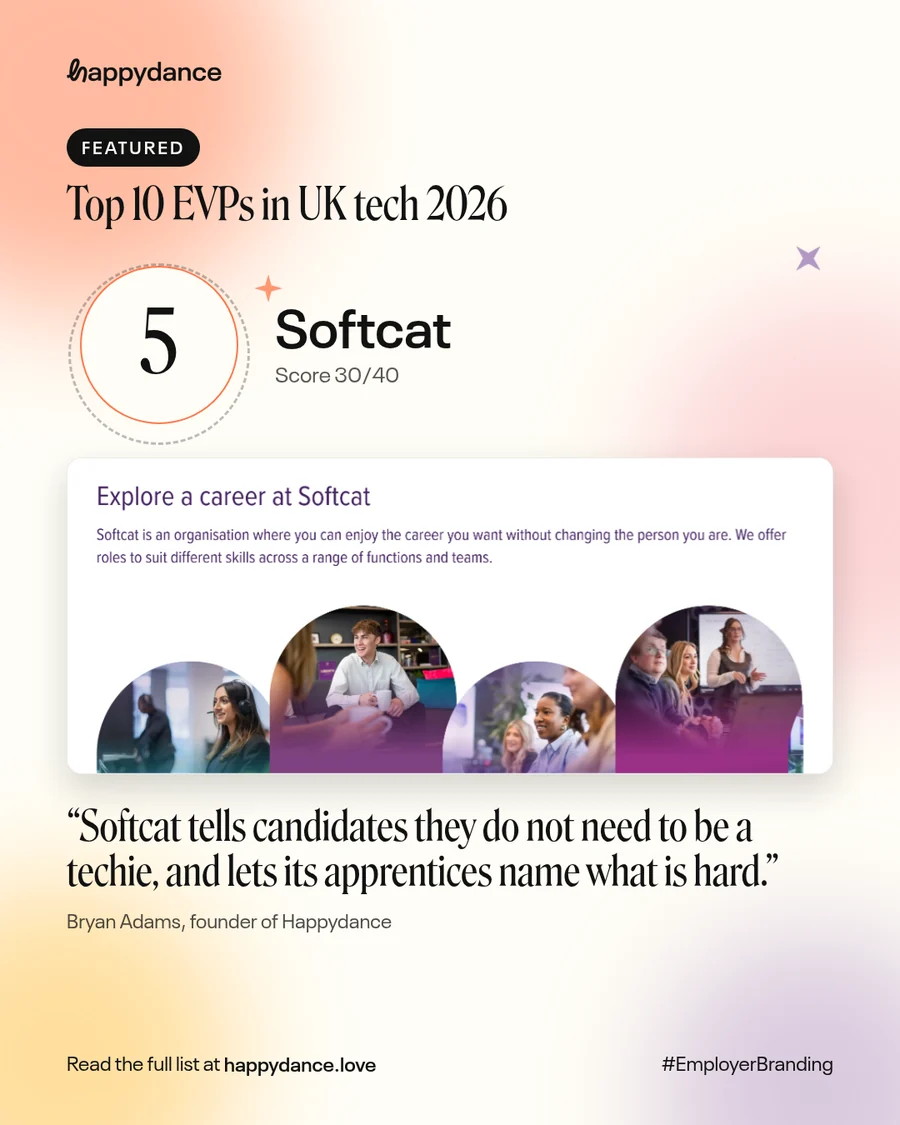
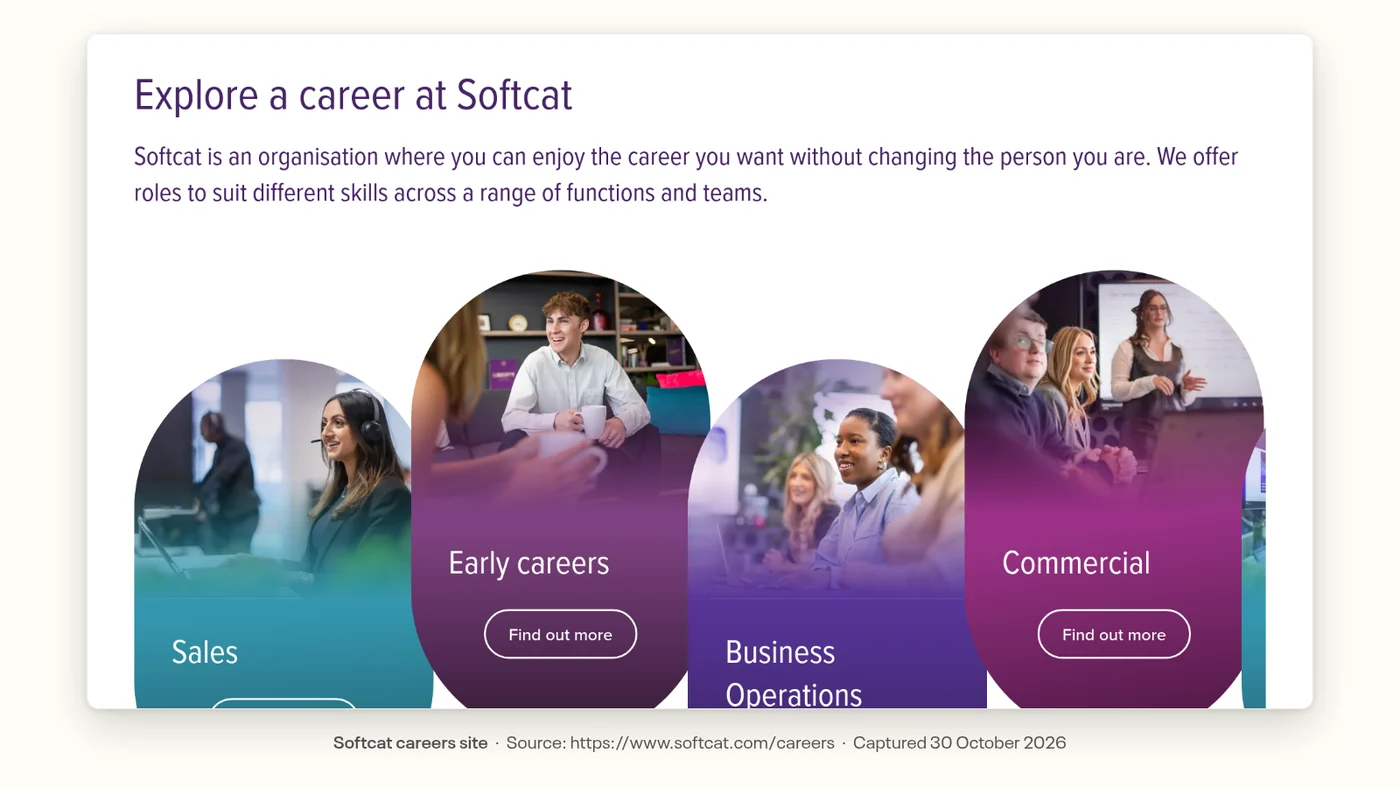
Softcat speaks directly to the people big tech often overlooks: “You don’t need to be a techie to succeed here, your personality, passion and drive set you apart.” It is an inclusive, confident promise, and it is backed by a library of #MyLifeatSoftcat stories from apprentices, engineers and team leaders.
The Give and Get
The Give is drive and ambition. The Get is shared success, said plainly: “We share our financial success with the employees who drive it.”, with “uncapped commission in sales”. And the culture line is affectionate and specific: “We’re a billion-pound tech business that still feels like a family.”
The story proof
Madina Sadaf, a Cyber Security Apprentice, names the hard part: “For me the biggest challenge has been the imposter syndrome.” She explains why: when you are the only apprentice in the area, “it feels like everyone else knows what they’re doing and I’m the anomaly.” Then the change: “it’s okay not to know what you’re doing since you’re in the process of learning.” Her advice is pure Softcat: “if you don’t ask, don’t expect.”
What we can all learn
Let apprentices say what is hard. Imposter syndrome named honestly is far more reassuring to an 18-year-old than another photo of a smiling graduate.
How to get more from the careers website
Bring the #MyLifeatSoftcat stories onto the main careers page, starting with an apprentice and a senior engineer side by side, so candidates see both the first step and where it can lead.
Sky makes the scale of the work the invitation: “Want to see your work in the hands of millions?” And it gives everyone a place in that promise, from the campus to the contact centre to the shop floor: “You can find your something, and your somewhere, at Sky.”
The Give and Get
The Give is ambition and responsibility: “We are fair and act with integrity, each one of us taking responsibility.” The Get is “the best seat in the house”, with a hiring process that promises clarity: “At Sky, we want your recruitment experience to be clear, fair and engaging.” and “We’ll keep you updated on the outcome as soon as possible.”
The story proof
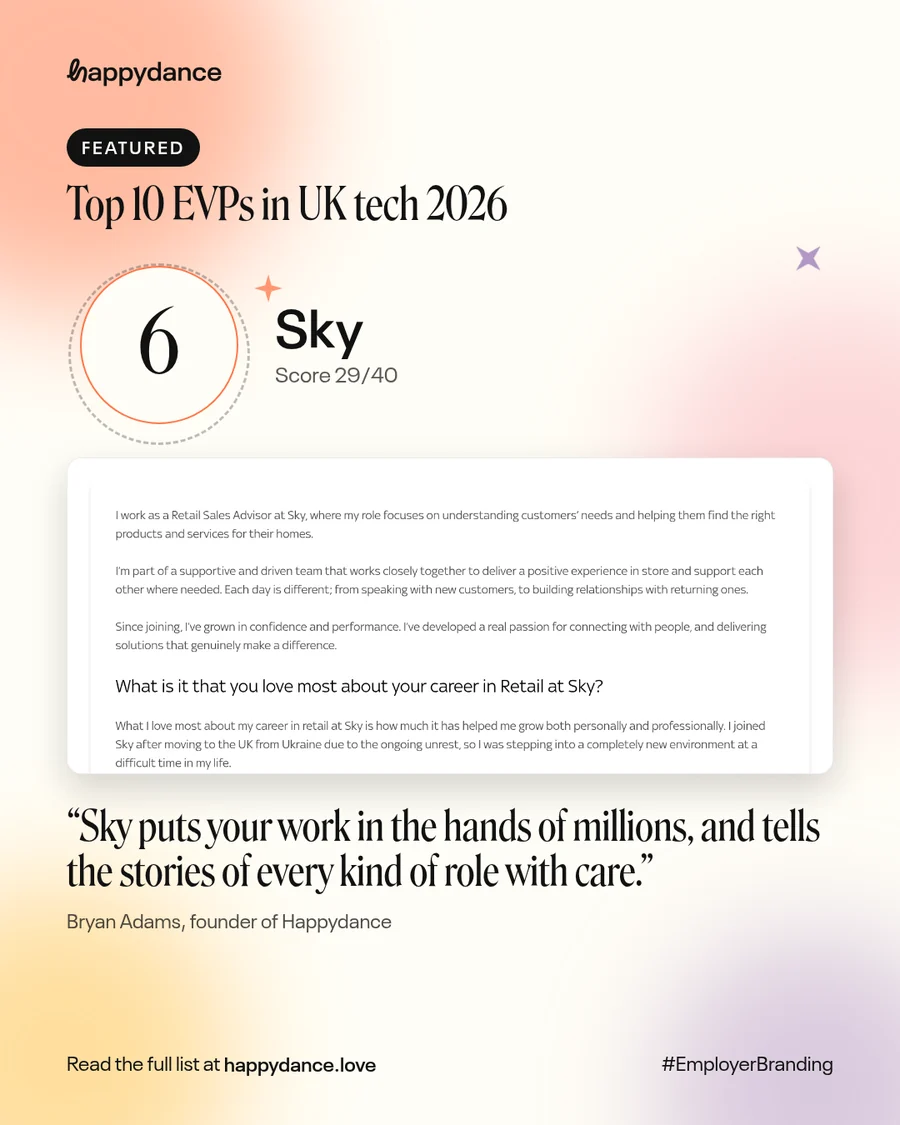
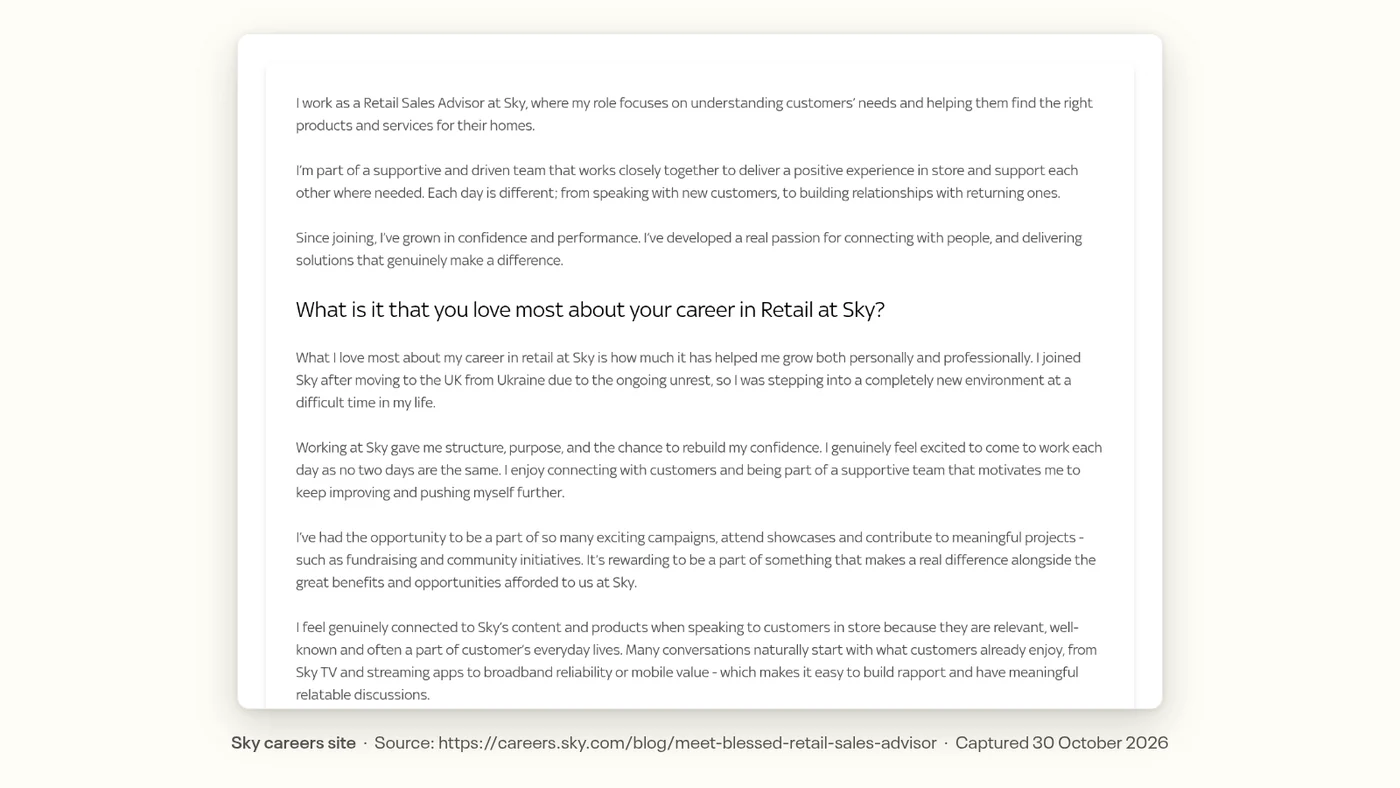
Blessed, a Retail Sales Advisor, tells a story of real courage: “I joined Sky after moving to the UK from Ukraine due to the ongoing unrest, so I was stepping into a completely new environment at a difficult time in my life.” The change is just as clear: “Working at Sky gave me structure, purpose, and the chance to rebuild my confidence.” It is a story about a store role, told with the same care as any engineering profile.
What we can all learn
Tell the stories of every kind of role. A retail advisor rebuilding her confidence says as much about a culture as any product launch.
How to get more from the careers website
The application journey page is clear and reassuring. Link it from each story, so a candidate inspired by Blessed can see exactly what happens after they press apply.
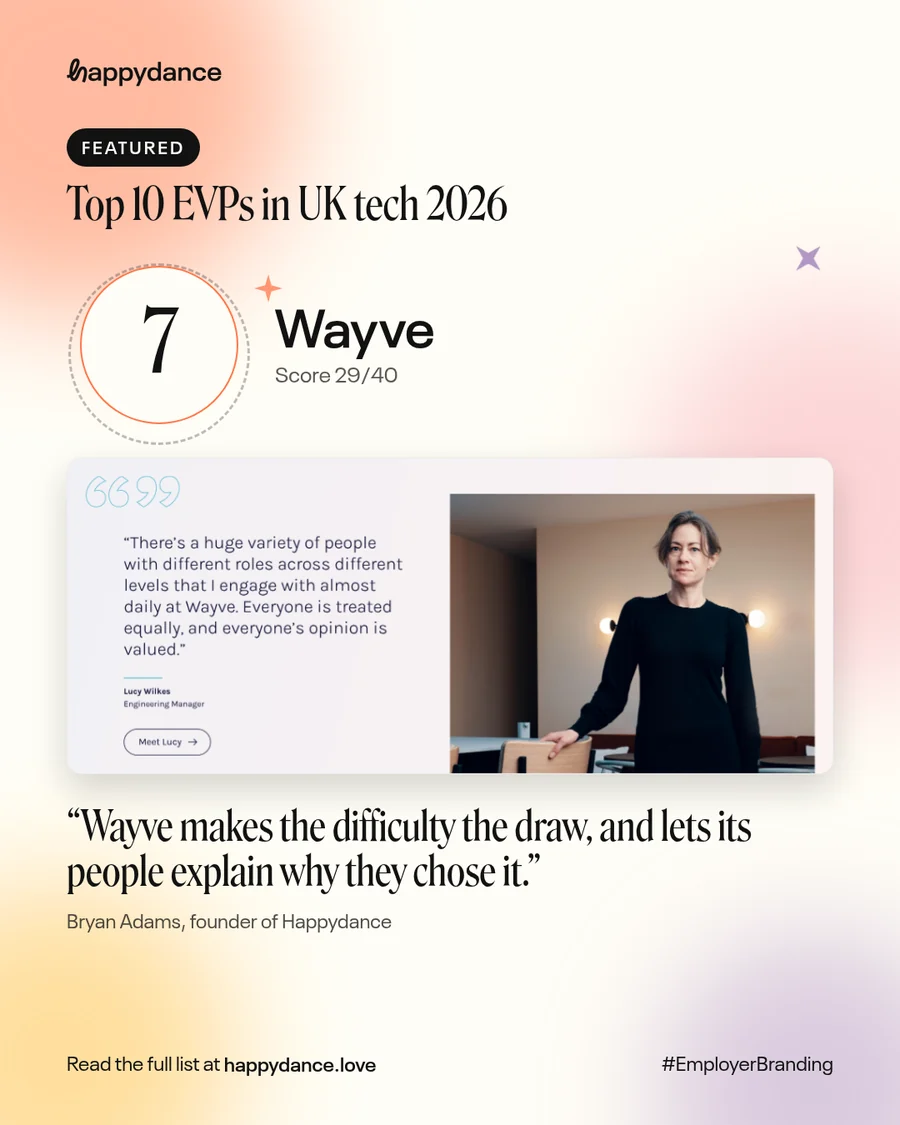
Wayve is honest about the size of the challenge: “We recognize we are tackling one of today’s hardest technological problems.” And it frames that difficulty as the attraction: “Where others see barriers, we lean into uncertainty and see opportunities for brilliant breakthroughs.” Its origin story fits: “Wayve was born in Cambridge as a ‘contrarian’ start-up”.
The Give and Get
The Give is comfort with the unknown. Zak Murez, an Applied Scientist, puts it best: “It’s about embracing uncertainty and diving headfirst into the unknown.” The Get is a seat on a mission. Alex Persin, Principal Engineer: “When I look back on this chapter of my career, it will be great knowing I was part of something positive that will bring a huge change to the world.”
The story proof
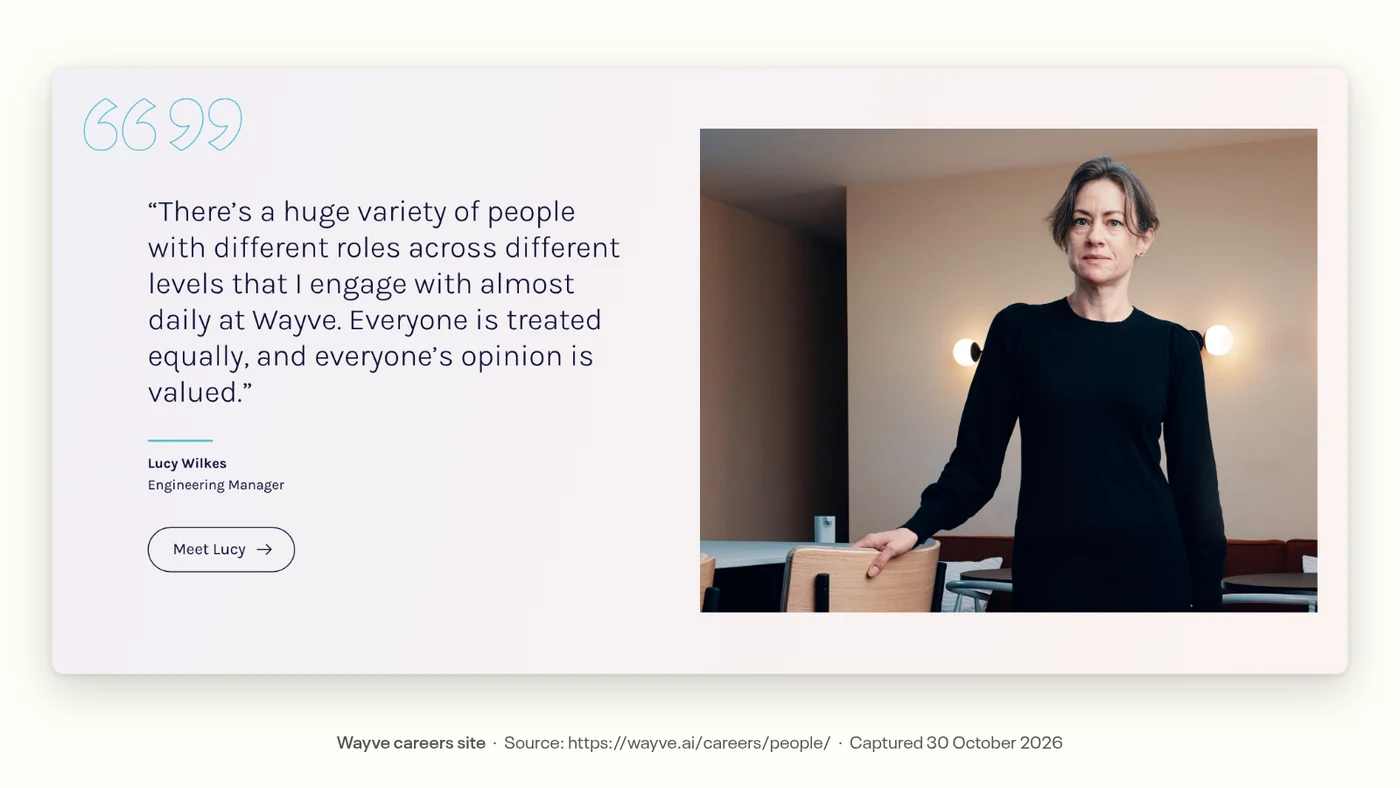
Lucy Wilkes, an Engineering Manager, explains why she joined with candour: “As a woman in technology, the lack of gender diversity has been most noticeable to me during my career”. Wayve’s commitment to a wide range of backgrounds was a big reason she came, and her verdict is simple: “Everyone is treated equally, and everyone’s opinion is valued.”
What we can all learn
Make the difficulty the draw. For the right candidate, “one of today’s hardest technological problems” is the most attractive line on the page.
How to get more from the careers website
The Meet our People profiles are strong. Add a few more voices from outside engineering, such as operations and safety drivers, so the whole Wayve team is visible.
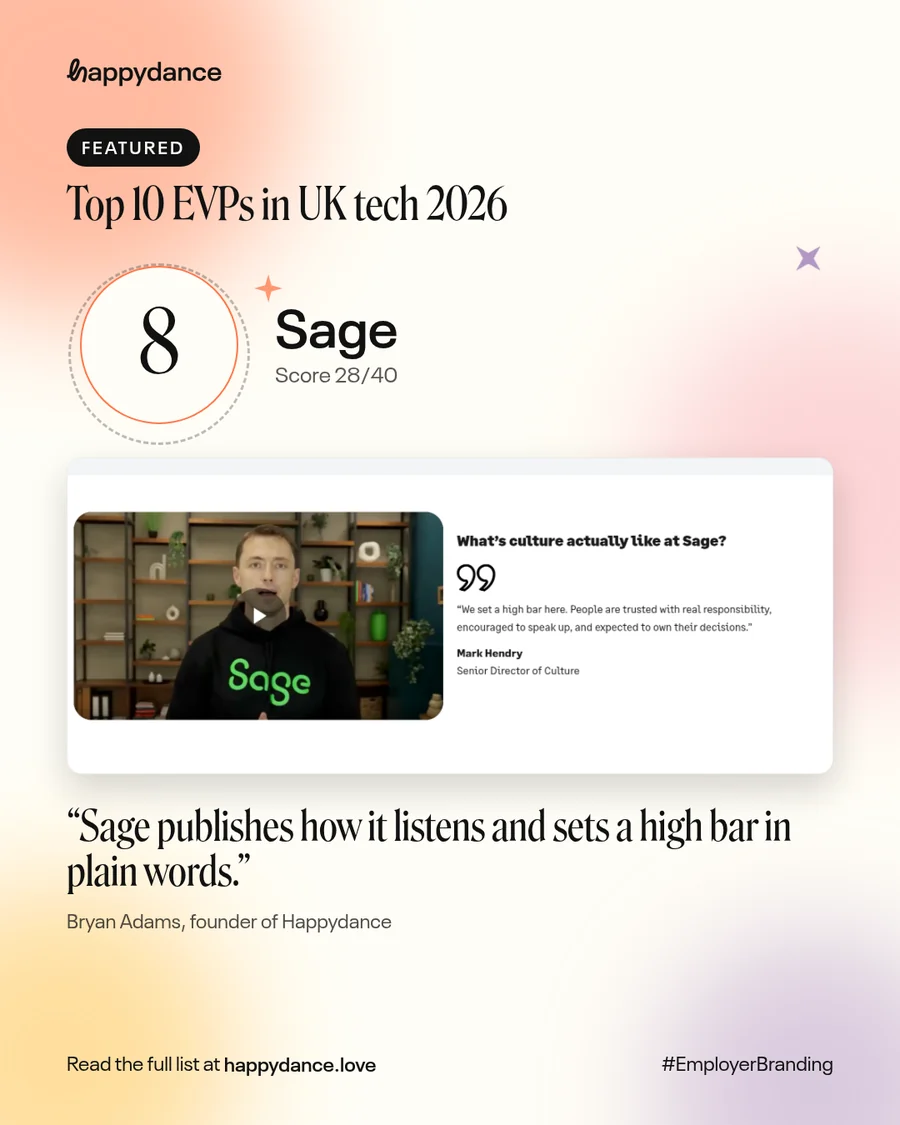
Sage publishes how it listens, and admits it is unusual: “Every six months, colleagues let us know what we’re doing well and where we can improve. Sure, this is uncommon, but it’s what we do with the results that sets us apart.” Its hiring FAQ answers the questions candidates actually worry about, starting with “Is someone actually reviewing my application?”
The Give and Get
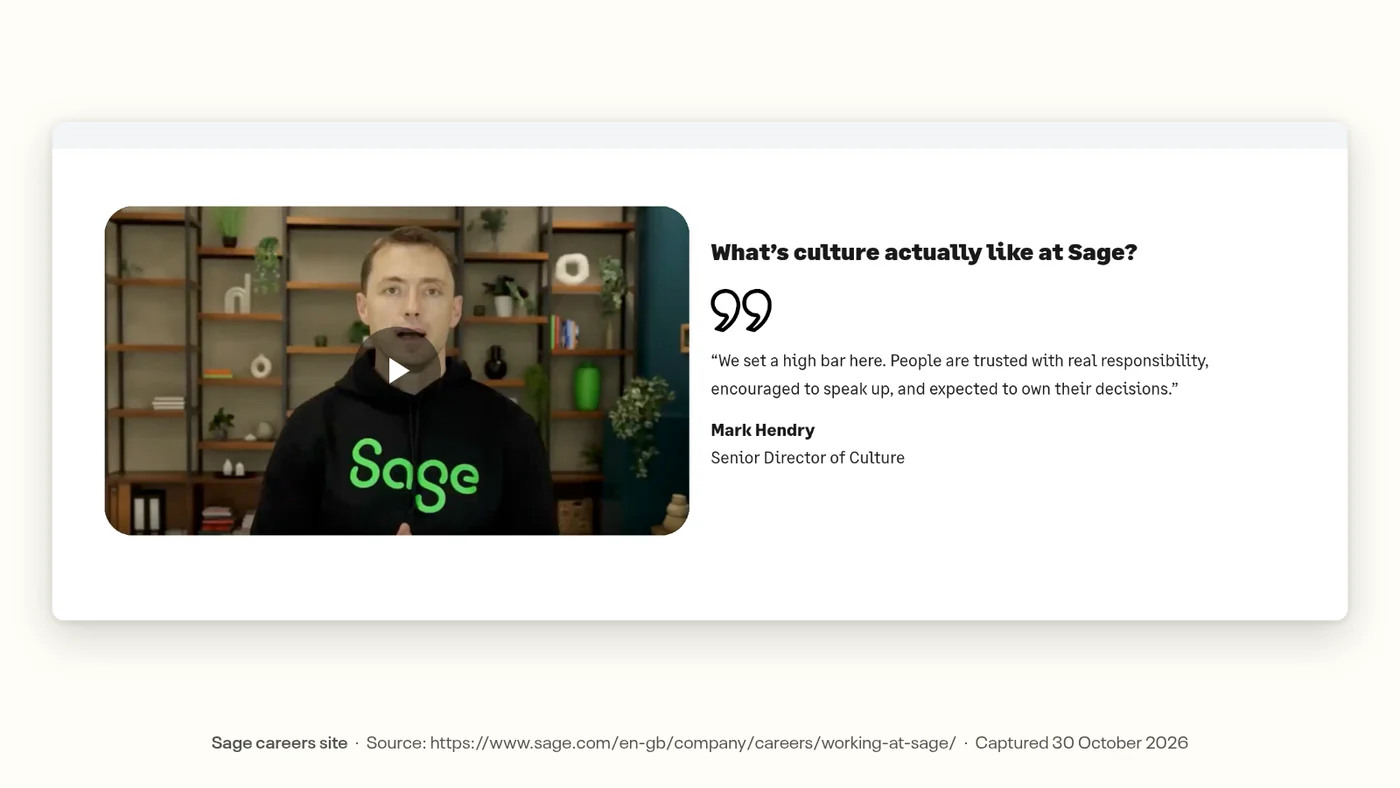
The Give is a high bar: teams are “energised by a high challenge, high reward culture.” Mark Hendry, Senior Director of Culture, spells it out: “We set a high bar here. People are trusted with real responsibility, encouraged to speak up, and expected to own their decisions.” The Get includes rare flexibility: “colleagues can work remotely for up to 10 weeks from over 40 countries.”
The story proof
The voices on the careers pages are mostly leaders, which is why Sage scores lower on story proof. The material for great stories is all there, from the 10-week work-away option to internal mobility.
What we can all learn
Show the feedback loop. Saying how often you ask, and what you do with the answers, is a whole-truth signal candidates rarely see.
How to get more from the careers website
Add colleague stories next to the benefits, such as someone who used the 10-week work-away option or moved teams through internal mobility, so the promises come with names attached.
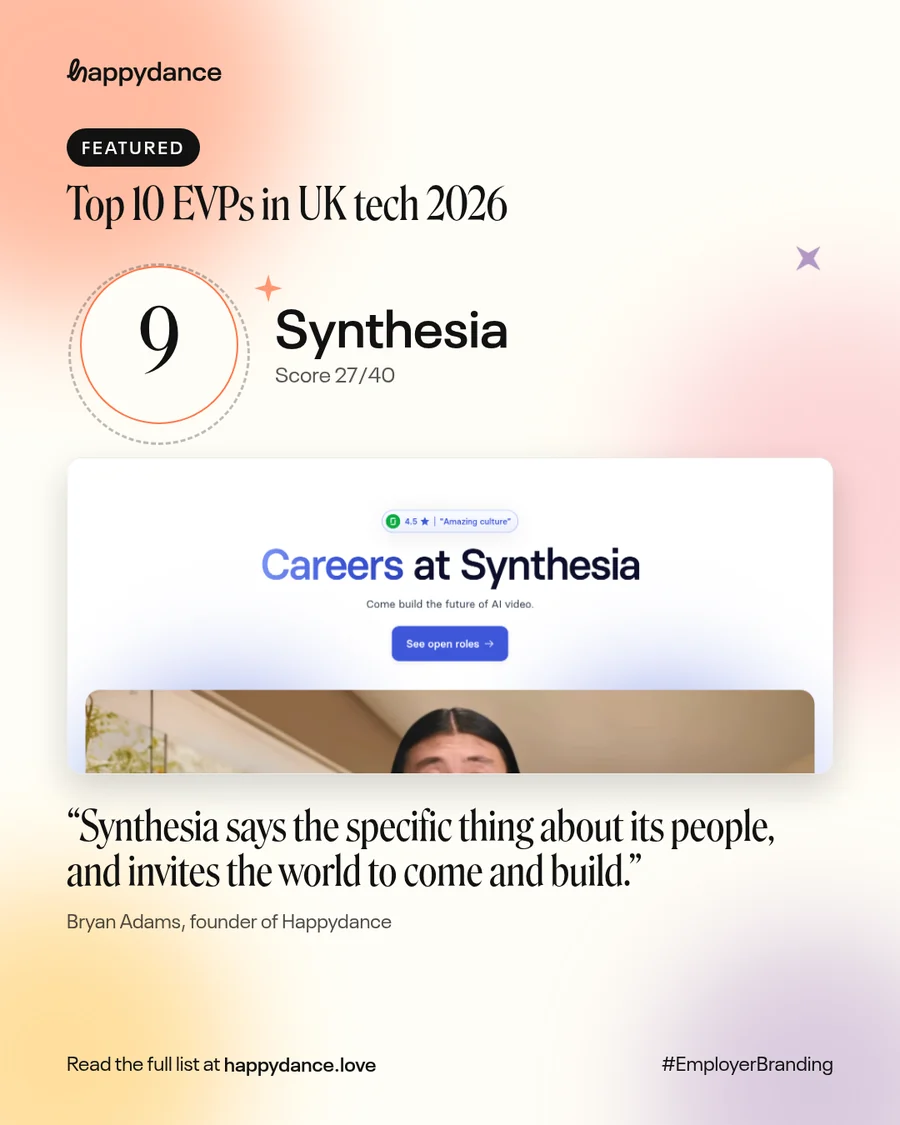
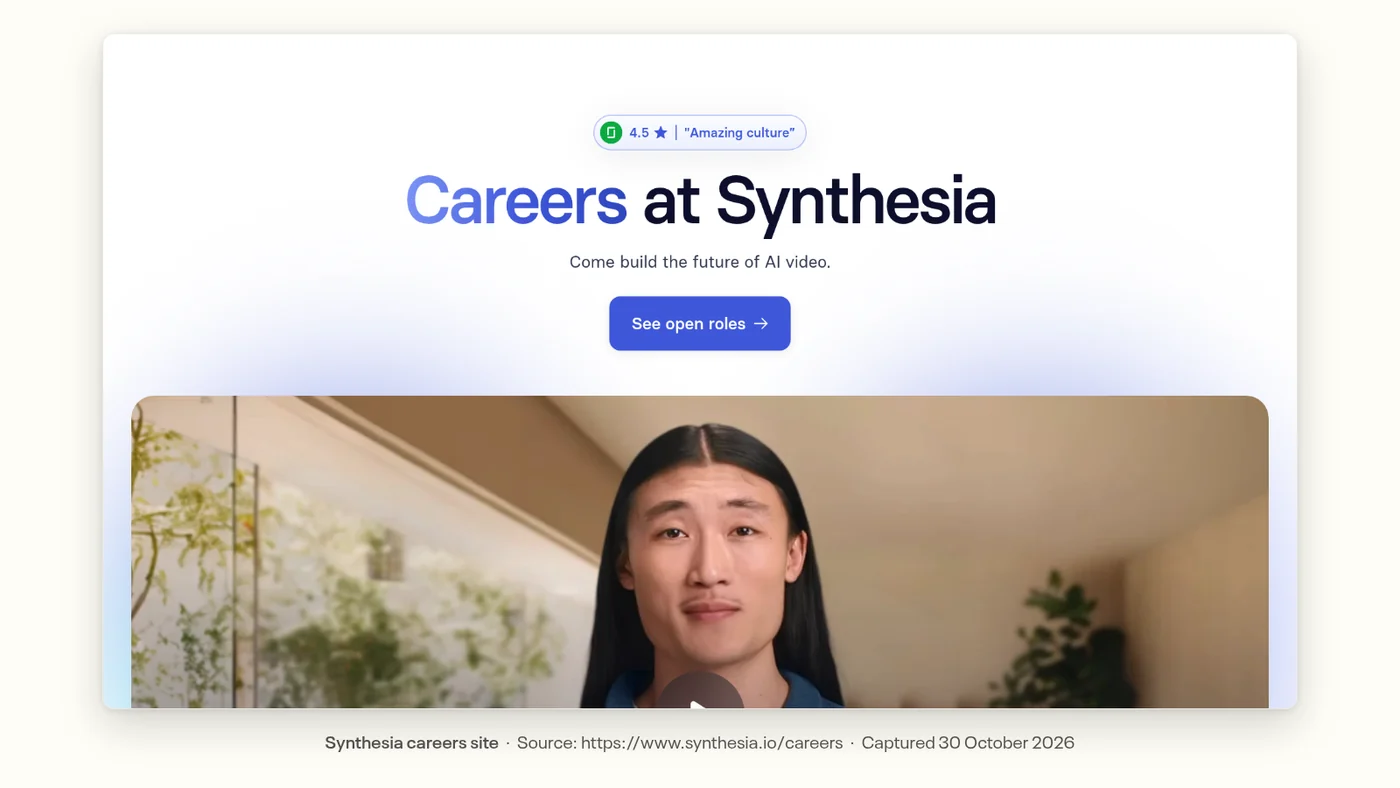
Synthesia’s co-founder and CEO, Victor Riparbelli, uses the careers page to make a point few employers would: “roughly 80% of our staff in our London HQ are immigrants.” It is a bold, specific statement about who builds the company, and it speaks directly to international talent choosing where to work.
The Give and Get
The Give is pace and ambition: “We’re a passionate, global team looking for ambitious people to help businesses work, train, and communicate better.” The Get is growth: “We give people real ownership, clear progression paths, and the support to level up in their careers”, and balance: “We take work-life balance seriously”.
The story proof
The voices on the page are leaders, with short videos from the CTO, Chief of Staff, CRO and General Counsel. Employee stories from across the team are the next step, which is why Synthesia scores lower on story proof.
What we can all learn
Say the specific thing. One clear fact about your people, like where they come from, does more than a paragraph about diversity.
How to get more from the careers website
The leadership videos set the tone. Add the same format for engineers, researchers and customer teams, so candidates hear from people in the roles they are applying for.
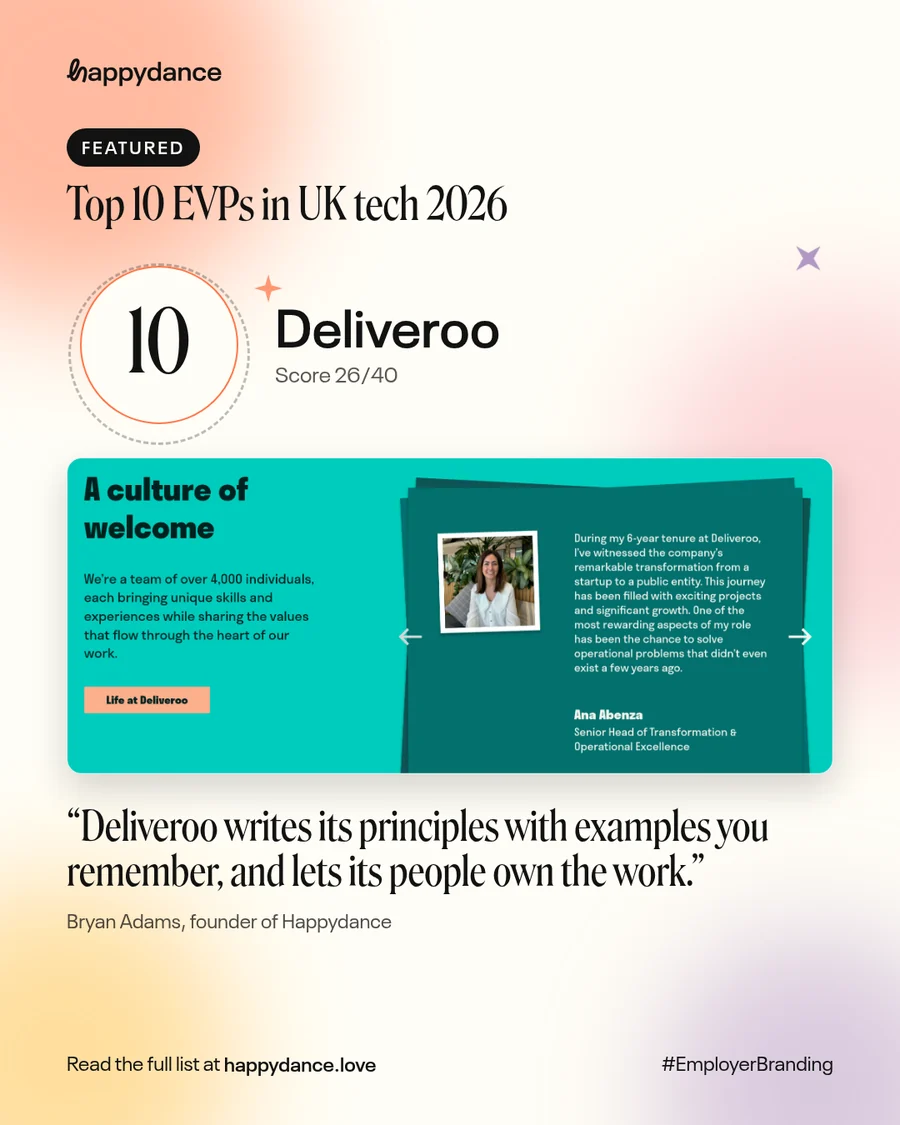
Deliveroo’s operating principles are some of the most plain-spoken in the sector: “Being wrong quickly is often better than being right slowly.” Its example of acting without over-analysis is memorable: “if there’s milk spilled in aisle seven, you don’t A/B test whether to clean it up, you clean it up”.
The Give and Get
The Give is speed and ownership. The Get is work with your name on it: “Seize the opportunity to deliver career-defining work that you can put your name to with pride.” Vasilis Vryniotis, a Senior Staff Machine Learning Engineer, describes what ownership means: “Our engineers have end-to-end ownership of the life-cycle of the Machine Learning models”.
The story proof
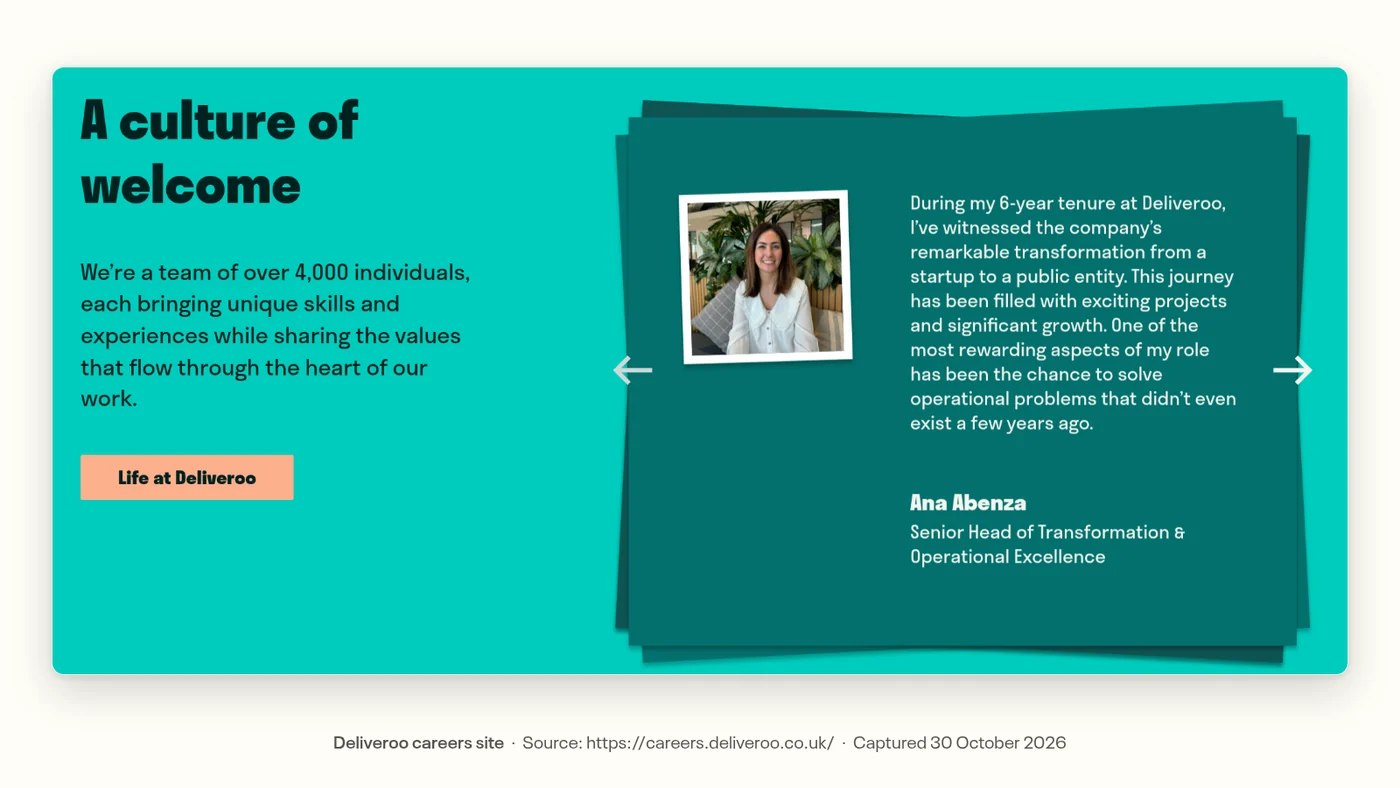
Ana Abenza, Senior Head of Transformation and Operational Excellence, gives the long view: “During my 6-year tenure at Deliveroo, I’ve witnessed the company’s remarkable transformation from a startup to a public entity.” Annie Baldwin, a Data Scientist, adds growth through community: “Being a part of the Women in Tech community and the BelEve programme has helped me grow professionally.”
What we can all learn
Write principles with examples. Milk in aisle seven explains a bias for action better than any definition.
How to get more from the careers website
The employee quotes are a strong start. Link each one to a fuller story, so candidates can follow Ana’s six years or Annie’s growth in their own words.
What we can all learn from the best EVPs in UK tech
Side by side, these ten share five lessons.
1
Say who it is not for. Thought Machine says plainly that it is not for everyone. Autotrader names the minimum days in the office. Honesty filters better than any job description.
2
Publish the unconventional route. Kainos tells Yasmine’s story from failing ICT to a First. Arm tells Phil’s journey from police analyst to software engineer. Helping candidates see where they will thrive starts here.
3
Name the hard part in the employee’s own words. Greg at Autotrader and Madina at Softcat both talk about imposter feelings, and both tell you how they got past them.
4
Let your people tell it. Autotrader, Kainos, Arm, Sky and Wayve prove their promises with first-person employee stories where the employee is the hero. As I wrote in Sell The Truth, “These are not testimonials. They are social proof at human scale.”
5
Say “in return”. Kainos uses the words. Thought Machine makes every employee a shareholder. Autotrader lists the shares, the holiday and the volunteer days. The Get is most convincing when it is specific.
If you want to see how your own EVP measures up, run it through the free Employer Brand and EVP Grader on the Employer Brand Atlas, the Happydance community for employer brand people. And if you would like a fresh pair of eyes on your careers website, our careers website audit is a good place to start.
Frequently asked questions
What is an EVP in tech?
An employer value proposition (EVP) is the deal between an employer and its people. Give & Get Employer Branding frames it as a value exchange: what your people give, and what they get in return. In UK tech the Give often includes pace, high standards and, increasingly, time in the office, so the best EVPs name it honestly and show what people get back.
What are the best employee value proposition examples in UK tech?
In our 2026 list, Autotrader, Kainos and Arm lead. The best EVP examples in UK tech state the Give and the Get together, say who the role is not for, and prove their promises with first-person employee stories.
Which UK tech company has the best EVP in 2026?
In our 2026 review of UK tech careers websites, Autotrader scored highest (34 out of 40), ahead of Kainos (32) and Arm (32, separated on the whole truth).
How can I improve my own EVP?
State what you ask of people as clearly as what you offer, then prove each claim with a real employee story. The free EVP grader on the Employer Brand Atlas gives you a quick read on where to start.
By clicking "Accept All", you agree to the storing of cookies on your device to give you the most optimal experience using our website. We may also use cookies to enhance performance, analyse site usage and to personalise your experience.