


Posts

Posts


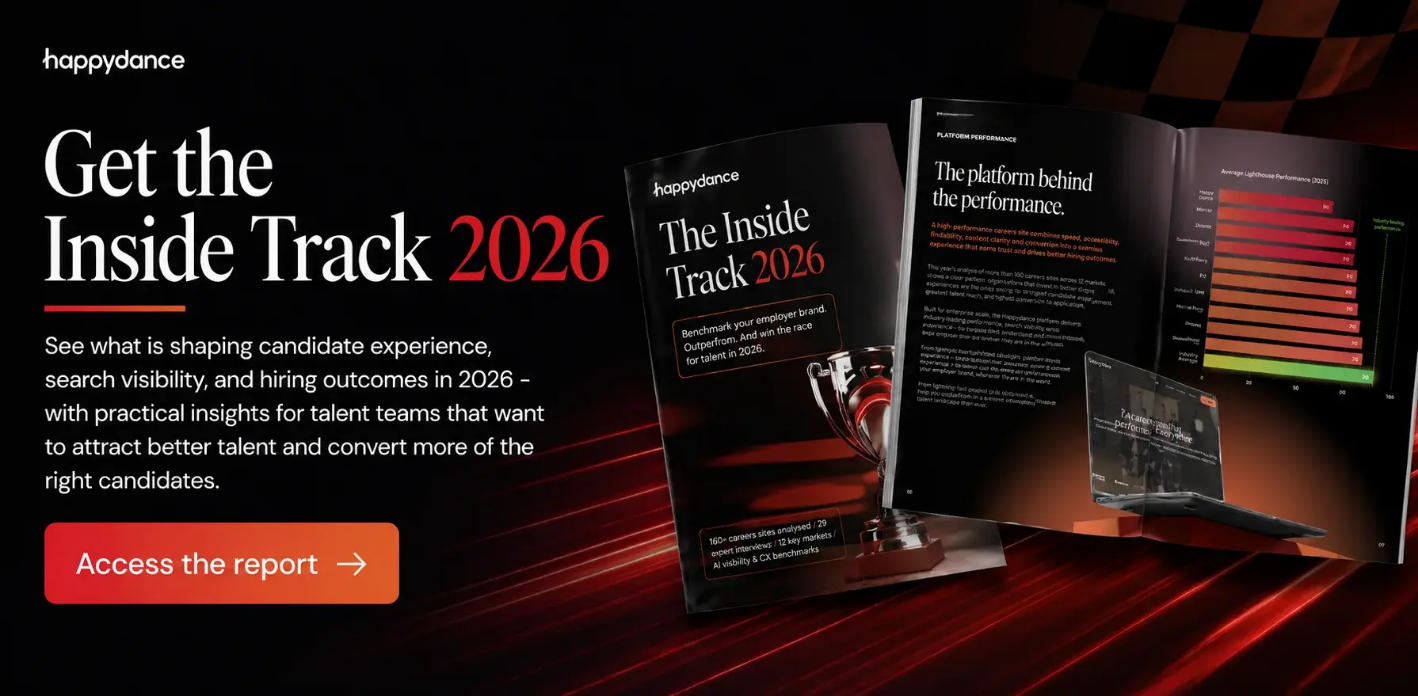
Want to see how careers websites are performing in 2026? Access The Inside Track 2026 report and explore the benchmark data
I spend most of my time talking to teams about careers, website architecture and performance. The conversation usually starts in the same place. Someone mentions a technical problem. The website is slow. The mobile experience is broken. The page is too heavy. The content is not structured in a way that search engines can understand.
And then someone else in the room usually says something like, “Well, that is a web team problem. Not really a hiring problem.”
I get it. There is an instinct to silo these things. Web performance sits with engineering. Candidate experience sits with talent acquisition. They are different jobs, different teams, and different budgets. But that siloing is exactly where careers websites stop performing.
Technical performance is where candidate experience starts, whether teams realize it or not.
Let me be very concerned about this. A candidate has just received a notification about a role at your company. They are interested. They click through. The page starts loading. It takes five seconds. Six seconds. Seven seconds. They are now waiting. And they are forming an opinion about what that wait means.
That opinion is not: the web team is probably working on this. The opinion is: this organization is slow. This organization does not have forward momentum. This organization may not be the kind of place I want to work.
I am not exaggerating the impact of this. You can measure it. When page load time increases from two seconds to five seconds, research consistently shows bounce rates rise sharply. Google's data puts the increase at 90%. The candidate who clicked through to evaluate you has already done the hard work of
deciding to look. What happens next - in the two to seven seconds while your page loads - determines whether that interest converts to action or another tab closed.
Google's research found that 53% of mobile site visits are abandoned when pages take longer than three seconds to load. In a hiring context, where a candidate is evaluating you on their phone in the margins of their day, that window is not a technicality. It is the moment your employer brand either earns the attention it deserves, or loses it.
Most of my conversations about careers site performance hit the same problem. The desktop experience is fine. The mobile experience is the afterthought. Which means you have built a hiring experience that works well for candidates in an office with a fast connection and a second screen, and fails candidates commuting, in a field, or using a mobile device because that is what they have.
Your best candidates are often evaluating multiple opportunities in the margins of their day. In the car. On the train. During lunch. In between meetings. They are not sitting down at a desktop to evaluate you. They are checking you out on their phone quickly, with the expectation that the experience will just work.
When it does not work, they do not think I will come back to this on desktop. They think this is too hard. And they move on to the next opportunity.
The teams that are winning are treating mobile as the primary experience. They design for mobile first, then scale up to desktop. They know that if it works seamlessly on a phone with a 4G connection, it will work beautifully on desktop. But the reverse is not true.
Every extra script, every auto-playing video, every dependency that needs to load before the page is useful is a friction point. And it is not just a technical friction point. It is a signal about how that organization thinks.
When a page is heavy and complex, it usually means the page is trying to do too much. It is trying to tell your story, show your culture, prove your innovation, and help the candidate find a job, all at once. And the result is a page that does none of those things well.
The careers websites that perform best are usually the ones that are ruthless about what goes on them. The role information. The candidate journey. The application. Everything else is overhead. When you strip away the overhead, two things happen. The page gets faster. And the candidate experience gets clearer. It is hard to overstate how much this matters.
Page weight is not a technical problem. It is a clarity problem.
This is worth underlining because it does not get nearly enough attention. When accessibility is built into the structure of how you build careers sites, it is almost always better. Keyboard navigation that works properly. Content structure that makes sense. Typography that is readable. Motion that does not cause problems for people with vestibular disorders.
But more than that, building for accessibility forces you to think clearly about information architecture. If your page works well for someone using a screen reader, it also works well for someone who is scanning it quickly on mobile. If it works for someone with color blindness, it works better for someone reading it in bright sunlight on the train.
Accessibility is not a separate track. It is a forcing function for good design. And it absolutely matters to candidate experience.
One of the things that changed my thinking about careers website architecture was understanding how much structured content matters. Not just for search engines, though that matters. But for actual candidate experience.
When a role is described using structured data, a candidate can understand what the job is about more quickly. A system can match candidates against roles more accurately. An AI can help a candidate understand whether they are likely to succeed in that role. None of that is possible without structured content.
The teams that are building the best careers websites are the ones that understand that structured content is not an SEO detail. It is a candidate experience detail. It is how you make information useful to both humans and systems.
This is the bit that I think most organizations get wrong. A careers website is not something you build, launch, and then maintain. It is something you measure continuously and improve based on what the measurement tells you.
That means tracking page load performance across devices and network conditions. Tracking where candidates encounter friction. Tracking conversion rates through each step of the journey. Tracking which information structures helps candidates understand roles better. And then use that measurement to make better decisions about what to optimize next.
Most of the best performing careers sites I see are measured at least weekly, often daily. The teams running them treat the site like a product, not like a publishing platform. They iterate. They test. They measure. They learn.
Building a high-performing careers site is not just about hiring faster or better. It is also about signal. When candidates experience a careers site that is fast, clear, accessible, and well-structured, they are experiencing an organization that thinks about quality and user experience. That is a form of employer brand that is far more powerful than any mission statement.
Posts

Posts

Posts