


Posts

Posts


Employee value proposition training guide
Most EVPs are slogans. The Give and Get method builds a clear value exchange for each employer brand pillar, so you attract the right people and are honest about what it takes. Here is how it works and how to learn it.
Updated 31 October 2026Course facts checked against the live Academy pages on 31 October 2026.
Employee value proposition (EVP) training teaches you to define what an organisation offers and expects, in a way people can believe. The Give and Get method, from Give & Get Employer Branding, designs one EVP for each employer brand pillar as a value exchange: what people give, and what they get. This guide explains the method with chapter references, shows how to research it, and sets out which lessons on the Happydance Academy Employer Brand Strategy course teach it, using only what the course page states.
Bryan Adams has spent 20 years in agency work and has led employer brand for Apple, Nike and American Airlines. He is the author of three books, including Give & Get Employer Branding and Sell The Truth, has a TEDx talk with 1.4 million views, has written two articles for Harvard Business Review and has bylines in Forbes, Inc and Entrepreneur. The Academy presents its courses as a chance to learn from Bryan, and every course fact in this guide is taken from the Academy pages themselves.
Good EVP training does more than show you a template. It should teach you to find the truth inside your organisation, express it as an honest exchange, and test whether it holds. It should also teach you to tell it as story, because a value proposition that is only a statement is rarely remembered.
The book is clear that being right is not enough. In its introduction:
“Even if it’s true, your strengths, benefits, and opportunities aren’t enough on their own to constitute an effective employer brand and employee value proposition (EVP).”
Give & Get Employer Branding, Bryan Adams (2020), Introduction.
Strengths, benefits and opportunities are half the picture. The other half, the demands and realities, is what makes the proposition credible. That is the principle behind the whole method.
Here is our summary of the contrast. The first three rows follow the book. The last two are our reading.
| Traditional EVP | Give and Get EVP | |
|---|---|---|
| How many? | One EVP for the organisation | One EVP for each employer brand pillar |
| What is it? | Often a slogan or a snapshot of a strength | A clear value exchange from a common theme in the employee experience |
| What it says | Benefits, strengths and opportunities | The Give (what people provide, commit or sacrifice) and the Get (what they can expect in return) |
| Tone | Can read as aspirational and generic | Honest and specific |
| Aim | Appeal to as many people as possible | Repel the many and compel the few |
The book makes the contrast explicit in the chapter that compares the two frameworks:
“Rather than offering one EVP, we design one EVP for each employer brand pillar.”
Give & Get Employer Branding, Bryan Adams (2020), Traditional Employer Brand Framework vs. the Give and Get Framework.
“In the Give and Get framework, the EVP is never a slogan or a snapshot of an area of strength within the organization; we offer a clear value exchange that is taken from a common theme that can be found within the employee experience.”
Give & Get Employer Branding, Bryan Adams (2020), Traditional Employer Brand Framework vs. the Give and Get Framework.
The book adds that each pillar’s EVP is made up of its own value exchange, defined by a give (what an employee must be prepared to provide, commit, or sacrifice) and a get (what an employee can expect in return).
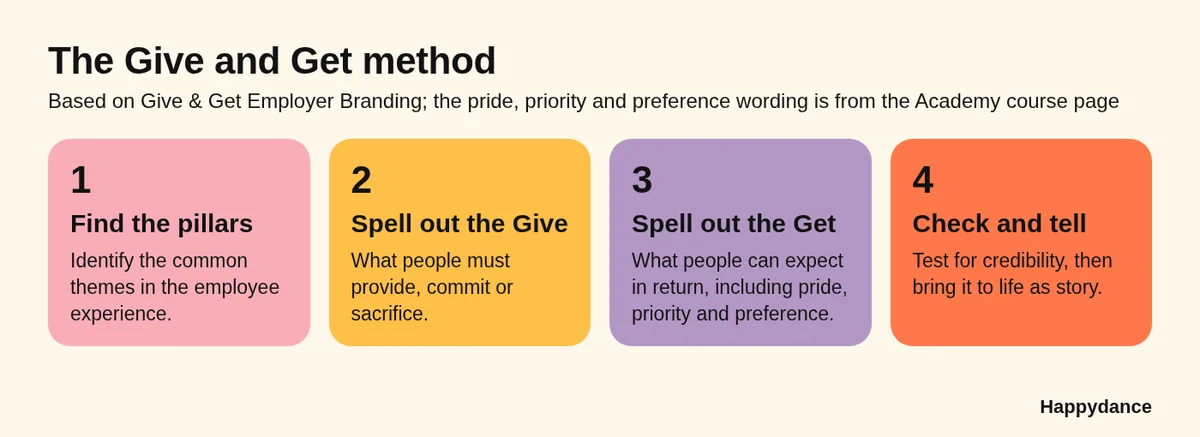
The book defines an employer brand pillar as follows, in its chapter on defining the terms:
“Employer Brand Pillar: An overarching, universal common theme of the employee experience.”
Give & Get Employer Branding, Bryan Adams (2020), Employer Brand and EVP Defined.
From there, the practical sequence is: find the pillars, then, for each one, state the Give and the Get as a pair, with a credible consequence linking what is asked to what is gained. The book also gives the purpose of an EVP in one sentence:
“Our approach to EVP is to identify the Give and the Get to articulate not only the benefits, strengths, and opportunities someone receives from working at your organization but also the demands, expectations, and realities of what it takes to really thrive.”
Give & Get Employer Branding, Bryan Adams (2020), Employer Brand and EVP Defined.
Being honest about demands is not a risk to attraction. It is how you attract the right people. The preface puts the aim in one line:
“This is how you “repel the many and compel the few” with the same message.”
Give & Get Employer Branding, Bryan Adams (2020), Preface.
And it adds the reason this honesty is valuable:
“After all, it’s your specific brand of difficult that makes you different.”
Give & Get Employer Branding, Bryan Adams (2020), Preface.
Both halves of the exchange come from listening. The book is specific that the heart of the research is emotional. In the Research Steps chapter:
“For both the Give and the Get, it always comes down to how people feel.”
Give & Get Employer Branding, Bryan Adams (2020), Research Steps.
“The most important insight you can hope to glean is a collective sense of what sacrifices and commitments must be made and why they make them.”
Give & Get Employer Branding, Bryan Adams (2020), Research Steps.
Here is a simple way to run the research, adapted from the principles above. It is our practical suggestion, not a lesson from the course.
“Your job is to find out what people are proud of and why.”
Give & Get Employer Branding, Bryan Adams (2020), Catching Truth.
See the Strategy course Module 2, Expectations, covers auditing your EVP, the Give and the Get, and rollout.
An EVP only works if people can feel it. The book recommends story structure for exactly this. In the chapter on using story architecture to build your employer brand story, it describes the And, But, Therefore technique as:
“This story technique is the simplest to use and the most valuable means of bringing your brand pillars to life by storifying each value exchange found within the pillar to a Give and a Get.”
Give & Get Employer Branding, Bryan Adams (2020), How to Use Story Architecture to Build Your Employer Brand Story.
The Academy Strategy course includes a lesson on storytelling using the And, But, Therefore framework in Module 3. For a wider look at frameworks you can use, see our guide to storytelling frameworks for business.
Before you publish any EVP, put it through these five questions. They are our own test, drawn from the principles above.
| Question | What a pass looks like |
|---|---|
| Is it an exchange? | There is a Give and a Get, and they are linked |
| Is it specific to us? | A competitor could not sign it without changing it |
| Is it honest about the demands? | The Give names real expectations and sacrifices |
| Is it grounded in how people feel? | You can point to research that supports it |
| Can we tell it as a story? | There is a real example for each pillar |
On the Employer Brand Strategy course page, Module 2 is called Expectations. The lessons listed are:
The course page lists the outcome Audit and define your EVP: access key frameworks to identify what is working about your current EVP and use those strengths to shape your future direction. Lessons combine video with structured exercises, and you submit an assignment to apply the frameworks to your own employer brand. The page states 12.5 hours, $247 and instant access, and the course is HRCI-accredited. For the full course picture, see our guide to employer brand strategy training.
Reading how others express a value exchange sharpens your own. Happydance publishes EVP examples by sector and sector lists for US tech, US healthcare, US retail, UK financial services and UK tech. As you read, apply the five-question check above and notice which examples offer a real exchange.
If your EVP is ready, the next job is making sure your careers website carries it. See our free careers website audit.
Employee value proposition training teaches you to research, define and test what an organisation offers and expects of its people. The Give and Get method builds one EVP per pillar as a value exchange rather than a slogan.
It is the method from Give & Get Employer Branding. Each employer brand pillar has its own EVP made of a give, what an employee must provide, commit or sacrifice, and a get, what they can expect in return.
Research how people feel, find the common themes, treat each as a pillar, then write the Give and the Get for each pillar as a linked pair in plain words. Test for specificity and honesty, and bring each pillar to life as a story.
The book defines employer brand as how people describe what it is like to work at your organisation. The EVP is the value exchange you design to shape that description: what you give, and what people get.
Yes. On the Happydance Academy, Module 2 of the Employer Brand Strategy course, Expectations, covers auditing your EVP, the Give and Get approach, the Give, the Get, rollout, and objectives, goals, strategies and measures.
The Employer Brand Strategy course is 12.5 hours in total, including the assignment. It is on demand with instant access.
The Employer Brand Strategy course is $247. The bundle with Employer Brand Development is $397, a saving of $97. Groups of five or more save 10% and groups of ten or more save 15%.
Yes, according to Give & Get Employer Branding. It says the EVP should articulate the benefits, strengths and opportunities and also the demands, expectations and realities of what it takes to really thrive.
Happydance publishes EVP examples by sector and several top 10 lists for the US and the UK. Links are in the examples section of this guide.
Work through the Give and Get approach in Module 2 of the Employer Brand Strategy course, with video, structured exercises and an assignment on your own organisation.
Explore the Employer Brand Strategy course
Every Academy student is welcome to book a conversation about their own employer brand with Happydance afterwards.
Posts

Posts

Posts